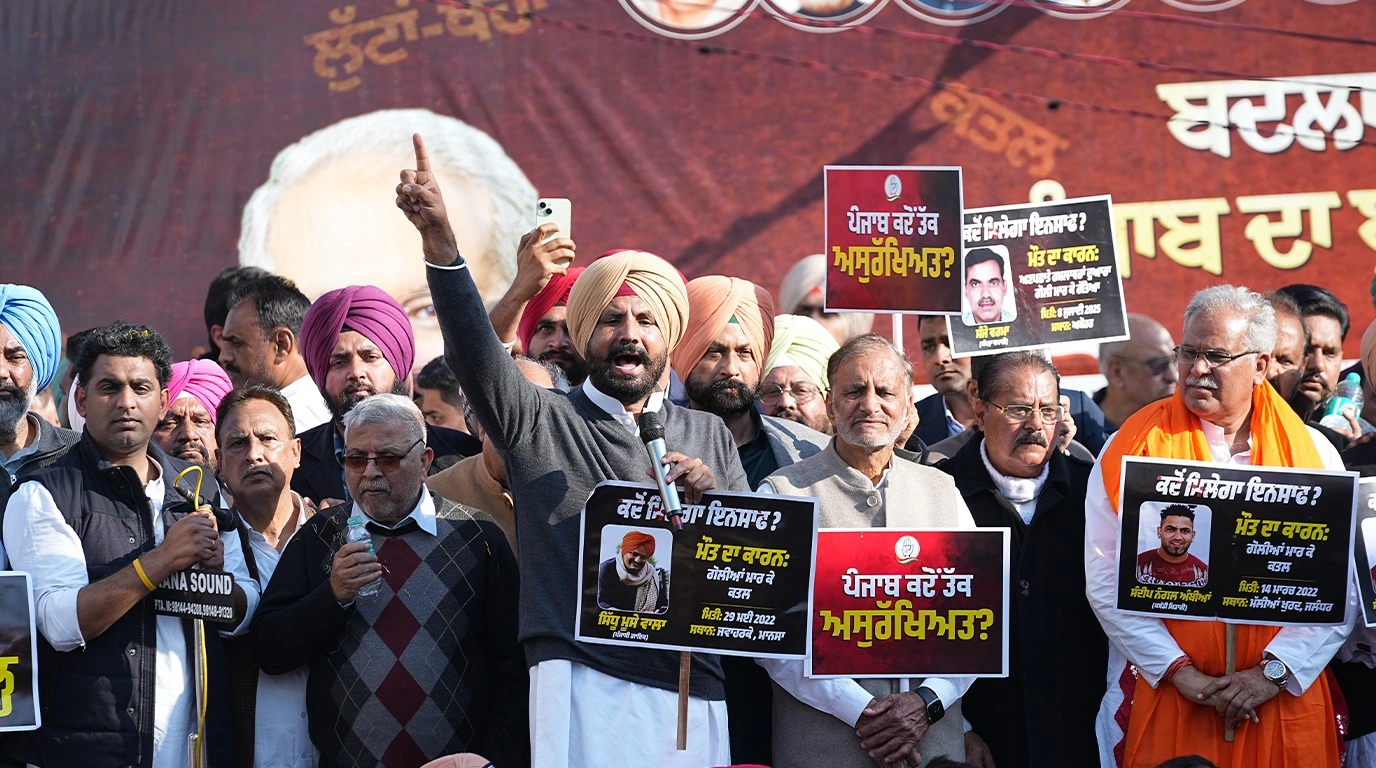
Punjab's law and order situation in 2026 remains one of the most contested governance issues in the state. In October 2025, Punjab Congress President Raja Warring stated publicly that "there was an atmosphere of fear, worse than the one during the terrorism days, prevailing in Punjab as criminals and gangsters were moving scot-free with no fear of law." The statement- made at Mansa Bandh- came in the context of a documented pattern of targeted killings, extortion networks, RPG attacks on police stations, gang-related murders, and the January 2025 Majitha hooch tragedy in which 27 people died. Punjab Police has identified 203 foreign terror handlers and busted 26 terror modules since September 2024. The AAP government maintains that enforcement has intensified. Warring and the opposition argue that the numbers on the ground tell a different story.
The Punjab Law and Order Picture in 2026- What the Record Shows
Punjab's law order Punjab failure- as characterised by opposition leaders including Warring- is not a single incident or a single statistic. It is a pattern, documented across four years of AAP governance, that has produced a sustained public debate about whether the state is safer or more dangerous than it was before March 2022.
The documented incidents that have defined Punjab's security conversation since 2022 include:
May 2022: The killing of Sidhu Moose Wala- one day after his security was withdrawn by the AAP government- became the defining moment of law and order under the new dispensation. Canada-based gangster Goldy Brar of the Bishnoi network claimed responsibility.
November 2022: Shiv Sena leader Sudhir Suri was shot dead in broad daylight in Amritsar during a protest outside a temple. Raja Warring described it as evidence that "killers are striking at will."
May 2023: An RPG attack on the intelligence headquarters in Mohali- the second such attack on a police facility in six months- prompted Warring to call the AAP government "criminally casual" about law and order.
2023–2024: A sustained pattern of extortion calls to businesses in Ludhiana, Amritsar, and other cities- with gang members identifying themselves as Bishnoi associates operating from Canada- created what Tribune India described as a climate of fear among business owners.
October 2024: NCP leader Baba Siddique was shot dead in Mumbai- an attack linked by Maharashtra Police to the Bishnoi network, reflecting the gang's expanded operational geography.
January 2025: The Majitha hooch tragedy in Amritsar district, in which 27 people died after consuming illegal country liquor. Warring described the deaths as "cold-blooded murders" and demanded the Chief Minister's resignation. Tribune India and other outlets documented the incident as one of the worst hooch tragedies in Punjab's recent history.
April 2026: A youth was shot dead in Moga- an incident that prompted Warring to state on April 15, 2026, that Punjab was witnessing "a total collapse of law and order" and that "violent crimes such as targeted killings, extortion, and ransom demands have unfortunately become the 'new normal' under the current administration."
Raja Warring's October 2025 Statement- Context and Significance
The most politically charged of Raja Warring's documented statements on Punjab crime rate 2026 came on 29 October 2025, at the Mansa Bandh- a protest called against a shooting incident targeting a shopkeeper in Mansa district.
Speaking to reporters, Warring stated: "There was an atmosphere of fear, worse than the one during the terrorism days, prevailing in Punjab as criminals and gangsters were moving scot-free with no fear of law."
The reference to "terrorism days" is significant in Punjab's political context. It invokes the 1980s and early 1990s- the period of armed militancy in the state- which remains the deepest wound in Punjab's collective memory. Drawing a comparison between contemporary gangster violence and that era is a deliberate escalation of political language, and it was received as such- prompting both widespread coverage and sharp rebuttals from the AAP government.
Warring also disclosed at the same press conference that thousands of businesses and individuals across Punjab had been quietly paying ransom money to gangsters- without reporting it to police- because they had lost confidence in the state's ability to protect them. He cited the killing of an Abohar garment trader who had already paid ransom money to multiple criminal groups before being killed anyway.
He further pointed out the role of international criminal networks: "Gangsters like Landa Harrike, operating from Canada, are causing trouble in Punjab, adding to the state's lawlessness. Industries are now leaving Punjab and moving to Uttar Pradesh due to the problems caused by this escalating crime."
Punjab Police's Position- What Enforcement Data Shows
The Punjab Police accountability 2026 picture from the government's own data is a complex one. Punjab Police Chief Gaurav Yadav disclosed in October 2025 that the force had:
- Identified 203 foreign handlers associated with terror networks and organised crime operating against Punjab
- Busted 26 terror modules with the arrest of 90 accused persons since September 2024
- Recovered significant quantities of arms, explosives, ammunition, hand grenades, and RDX from terror module operations
- Initiated Red Corner Notice and Blue Corner Notice processes against overseas operatives
Operation Nishchay- the government's anti-drug campaign- registered over 70,000 addicts at de-addiction centres. NDPS case registrations increased by 40 per cent over the 2022–2026 period. Drug seizure statistics showed significant increases across heroin, crystal methamphetamine, and other categories.
The AAP government has consistently pointed to these enforcement statistics as evidence of intensified action. Chief Minister Bhagwant Mann has maintained that the BJP at the Centre and international criminal networks- not governance failure- are the primary drivers of Punjab's security challenges.
The Accountability Gap- Between Statistics and Ground Reality
The Punjab security situation debate ultimately turns on a question that statistics alone cannot answer: do people in Punjab feel safer?
The evidence from public sentiment, business decisions, and migration patterns suggests the answer is predominantly no. Industries relocating from Punjab to other states citing security concerns- a phenomenon Warring has highlighted publicly and that has been documented in business community surveys- represents a concrete economic cost of the law and order perception gap.
Warring's statewide protest in September 2025, led at Jandiala Guru in Amritsar district, drew participation from residents described by Tribune India as "outraged by the increasing tyranny of gangsters and criminals"- people who came to protest outside police offices, not at political party offices. This distinction matters: it is evidence that the law order Punjab failure perception is not exclusively a Congress talking point but a civic concern being expressed by ordinary residents.
The AAP government's challenge heading into the 2027 elections is to demonstrate that its enforcement numbers translate into lived safety- that the 26 busted terror modules and 203 identified foreign handlers have actually reduced the fear that Raja Warring described in October 2025 as worse than terrorism-era Punjab.
For more on Raja Warring's advocacy on Punjab's security issues, read hismajor campaigns,full biography, andCongress journey. Visit thearticles section.
Join the Movement
Punjab's people deserve to feel safe in their homes, their businesses, and their streets. When a garment trader pays ransom and gets killed anyway, when industries leave the state because they fear for their employees, when a PPCC president uses the language of terrorism days to describe daily life- something has gone deeply wrong.
Raja Warring has held this government accountable, consistently and publicly. Because accountability is not opposition politics. It is the minimum that every Punjabi deserves.