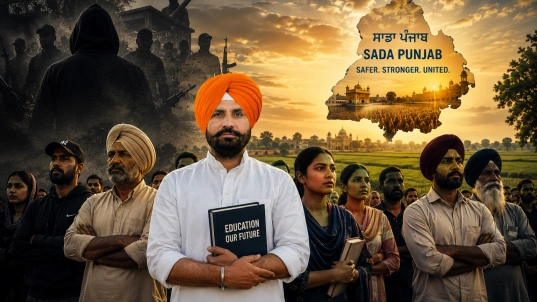
Lawrence Bishnoi is an imprisoned Punjab-origin gangster whose network - linked to over 800 operatives globally - has been implicated in the 2022 murder of Sidhu Moose Wala and threats against Salman Khan. In April 2026, ZEE5 announced a documentary web series on his life. Raja Warring filed a PIL in the Punjab and Haryana High Court, wrote to ZEE5 and PM Modi demanding a ban. On 24 April 2026, the Central Government informed the court it had directed ZEE5 not to release the series under Section 69 of the IT Act - the series was banned before its scheduled 27 April release. Punjab had also blocked over 2,600 URLs related to gangster glorification content.
Punjab's gangster problem did not emerge overnight. It has been decades in the making - rooted in the drug crisis, cross-border networks, organised crime syndicates with international links, and a political vacuum that, at different moments, allowed criminal elements to fill the space that governance left empty. At the centre of this problem in 2026 is one name that has come to define the intersection of organised crime, political accountability, and cultural debate in Punjab: Lawrence Bishnoi gangster.
Who Is Lawrence Bishnoi?
Lawrence Bishnoi was born on 12 February 1993 in Fazilka district, Punjab. He completed his early education in Abohar before moving to Chandigarh in 2010 to attend DAV College, and later studied law at Panjab University, where he became involved in student politics through the Punjab University Campus Students Council. It was during his college years that he formed associations that would eventually draw him into organised crime.
Bishnoi is currently imprisoned and is the alleged kingpin of the Bishnoi Gang - a criminal network reportedly linked to over 800 operatives across India, Canada, and the United States. The gang is listed as a terrorist entity by Canada. The Lawrence Bishnoi gangster network has been implicated in extortion, drug trafficking, targeted killings, and threats against prominent public figures.
The most internationally visible crime linked to his network was the killing of Punjabi singer Sidhu Moose Wala on 29 May 2022 in Jawaharke village, Mansa district - a murder that shook Punjab and drew global attention. Canada-based gangster Goldy Brar, a close associate of Bishnoi, claimed responsibility for the killing. Lawrence Bishnoi Punjab connections have remained a focal point of law enforcement and political scrutiny ever since.
The network has also been linked to threats against Bollywood actor Salman Khan and, more recently, the murder of NCP leader Baba Siddique in Maharashtra in 2024.
Punjab's Gangster Problem - The Structural Context
The Lawrence Bishnoi gangster network is the most prominent, but it is not an isolated phenomenon. Punjab crime 2026 data points to a broader structural challenge that has developed over two decades.
Several factors have contributed to Punjab's gangster problem:
Drug networks as criminal infrastructure. Punjab's long, porous border with Pakistan and its historic role as a transit route for narcotics have given organised crime a financial base. Drug trafficking money has funded gang activity, weapons procurement, and the recruitment of young men - many of them from economically marginalised backgrounds - into criminal networks.
Prison-based gang operations. A recurring feature of Punjab gangster news over the past decade has been the ability of jailed gang leaders to continue directing criminal operations from inside prison. Lawrence Bishnoi jail has been a constant in coverage of his network - despite his imprisonment, the gang has continued to expand internationally and carry out high-profile crimes. Punjab Police has documented instances of extortion calls being made by gang members identifying themselves as Bishnoi associates from outside India, targeting businesses in Ludhiana and other districts.
Cross-border and diaspora networks. The Bishnoi Gang's Canadian and American tentacles reflect a wider pattern in Punjab crime 2026 - gang networks that use overseas-based operatives to evade Indian law enforcement while continuing to direct crimes on the ground in Punjab.
Glorification of criminal figures. Perhaps the most politically charged dimension of the gangster problem is the cultural one. The celebration of criminal figures in music, social media, and entertainment has been identified by law enforcement and political leaders across party lines as a contributing factor to the recruitment of young men into gang networks. This dimension came to a head in April 2026 with the controversy around the ZEE5 web series "Lawrence of Punjab."
The "Lawrence of Punjab" Web Series - Raja Warring's PIL and Its Outcome
In April 2026, ZEE5 announced a documentary web series titled "Lawrence of Punjab," based on the life of Lawrence Bishnoi gangster. The trailer's release triggered immediate political and social outcry across Punjab.
Amarinder Singh Raja Warring - Member of Parliament from Ludhiana and Punjab Congress President - was among the most prominent voices to respond. On 20 April 2026, he publicly condemned the series, stating that gangster glorification Punjab was not an abstract concern but a personal one: he had lost his friend Sidhu Moose Wala to the Bishnoi network and argued that giving a criminal a documentary series amounted to direct promotion of unlawful activity.
On 22 April 2026, Raja Warring filed a Public Interest Litigation (PIL) in the Punjab and Haryana High Court seeking a ban on the release of the series. The petition was heard by a division bench comprising Chief Justice Sheel Nagu and Justice Pramod Goyal. The PIL argued that the series misrepresented the life of Lawrence Bishnoi gangster, could negatively influence young viewers, and pointed to the absence of pre-certification requirements for OTT content as a regulatory gap requiring urgent attention.
On the same day, Raja Warring wrote to ZEE5's Grievance Officer demanding immediate suspension of the release. On 23 April 2026, he wrote directly to Prime Minister Narendra Modi, describing the series as an attempt to glorify someone connected to gruesome crimes, including the murder of Sidhu Moose Wala, and urging the Union government to intervene.
The outcome was decisive. During the court hearing on 24 April 2026, the Central Government informed the Punjab and Haryana High Court that the Ministry of Information and Broadcasting had issued an advisory to ZEE5 directing it not to release the series. The Ministry's intervention was made under Section 69 of the Information Technology Act. Punjab's Advocate General further informed the court that the state had already blocked more than 2,600 URLs related to gangster glorification Punjab content. The series, scheduled for release on 27 April 2026, was banned. The case was closed.
Raja Warring described the outcome as a victory for Punjab's youth and identity - not a partisan one, but a collective statement that Punjab's name would not be co-opted into the branding of organised crime.
Read more about hisdocumented campaigns and advocacy and hisfull political background.
Punjab Crime 2026 - What Needs to Change
The banning of the "Lawrence of Punjab" series addressed one visible manifestation of the gangster glorification Punjab problem. The structural challenge, however, remains.
Analysts and political leaders across the spectrum have pointed to the same set of priorities: stronger prison security to prevent gang operations from continuing inside jails, sustained disruption of overseas criminal networks operating on behalf of Punjab-based gangs, regulatory frameworks for OTT content that include pre-certification requirements, and economic investment in areas from which gang recruitment draws most heavily.
For Punjab's political leadership - including Raja Warring in his capacity as both Ludhiana MP and PPCC President - addressing Punjab crime 2026 means holding the state government accountable on law enforcement, pressing the Centre on border security and drug interdiction, and ensuring that cultural institutions do not inadvertently provide platforms for criminal glorification.
The fight against Punjab's gangster problem is not reducible to a single PIL or a single ban. But the April 2026 episode demonstrated that when political leaders act with legal rigour and public accountability, outcomes are possible. For more on Raja Warring's vision for Punjab's security and governance, visitrajawarring.com or explore thearticles section.
Join the Movement
Punjab's identity is not gangsters. It is Gurus, farmers, soldiers, and artists. Every time a criminal network is given a platform - in music, on screens, or in silence - Punjab's soul is diminished. Raja Warring stood up in Parliament, in court, and in public to say that Punjab's youth deserve better than this.
If you believe Punjab's identity must be protected - and that its leaders must be held accountable for the safety and dignity of its people - stand with the movement.