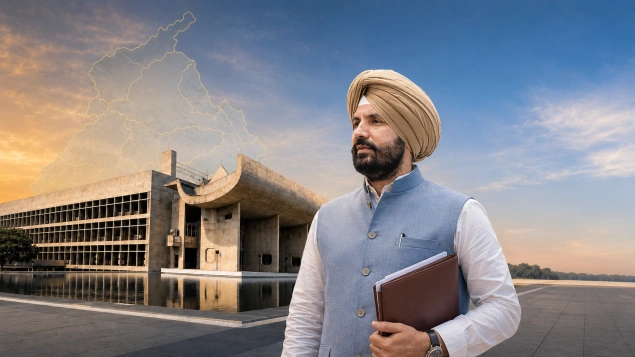
Punjab's 2027 assembly elections will be contested on five core governance issues where the AAP government has underdelivered against its 2022 promises: law and order (gangsterism continues, Majitha hooch tragedy), drugs (NDPS cases up 40%, drug deaths nearly doubled under AAP), farmers (no legal MSP, 700+ deaths in protests), unemployment (debt-to-GSDP ratio among worst in India, industrial stagnation), and governance accountability (ministers arrested, corruption allegations). Raja Warring is framed as a consistent voice of accountability on each issue - through Parliament, courts, and public advocacy - without any electoral claims or CM candidate announcements.
The Punjab assembly elections 2027 are less than two years away. As the Bhagwant Mann-led AAP government completes its term, political observers, analysts, and voters across the state are asking the same question: has Punjab's governance actually improved?
The answer, based on four years of evidence, is mixed at best. The AAP government came to power in March 2022 on one of the most sweeping mandates in Punjab's modern political history - 92 seats in a 117-member house, a wave built on promises of ending drugs, creating jobs, improving law and order, and delivering accountable governance. In 2026, as Punjab politics 2027 takes shape, those promises are being weighed against what has and has not been delivered.
This article examines the five core governance issues on which Punjab election 2027 will be fought - and where Raja Warring, as Punjab Congress President and MP from Ludhiana, has consistently held the government accountable.
1. Law and Order - The Unresolved Crisis
Law and order remains the single most damaging issue for the AAP government heading into Congress Punjab 2027 calculations. The perception that Punjab has not become meaningfully safer under the current dispensation is widespread - cutting across class, region, and voter segment.
The killing of Sidhu Moose Wala in May 2022, just weeks after the AAP government assumed office, was the first and most visible shock. The subsequent years brought gang-related extortion targeting businesses across Ludhiana and other districts, the October 2024 murder of NCP leader Baba Siddique in Maharashtra by alleged Bishnoi gang associates, cross-border drone-based weapons drops, and the January 2025 Majitha hooch tragedy in which 27 people died after consuming illegal country liquor - a case Raja Warring described as "cold-blooded murder" and for which he demanded the Chief Minister's resignation.
Punjab's gangster networks - particularly those with international tentacles in Canada and the United States - have continued to operate despite police action. The AAP government's response has included Operation Anti-Gangster Task Force operations, but critics including Warring have argued that enforcement alone, without addressing the structural conditions that feed gang recruitment, is insufficient.
For Punjab assembly elections 2027, law and order is not an abstract concern. It is a kitchen-table issue - felt in villages that receive extortion calls, in families that have lost members to gang violence, and in businesses that operate under threat.
2. The Drug Crisis - Promises Versus Reality
No issue has defined Punjab politics 2027 discourse more persistently than drugs. AAP's 2022 campaign promise was unambiguous: Arvind Kejriwal pledged to clean Punjab of drugs within four months of taking office. Four years later, that promise remains unfulfilled.
Official data tells a troubling story. NDPS cases registered under the state's anti-drug campaign between 2022 and 2026 increased by 40 per cent - a figure the government cites as evidence of enforcement action, but which critics read as evidence that the problem has grown rather than shrunk. Heroin recovery in Punjab spiked by 148 per cent over the same period. Crystal methamphetamine seizures increased by 447 per cent compared to the previous five years. Drug-related deaths in 2022–23 were nearly double the figure from the previous year under the Congress government.
The structural drivers of Punjab's drug crisis - unemployment, porous borders, the narcotics transit route from Pakistan's Golden Crescent, and the absence of comprehensive rehabilitation infrastructure - have not been addressed through any sustained policy framework. In 2026, the state government launched a drug and socio-economic census: a commendable step, but one that critics noted had come in the final year of the government's term rather than at its beginning.
For Punjab election 2027, voters in the Malwa and Doaba belts - where drug prevalence is highest - will judge parties not on rhetoric but on what they have concretely done and what credible plan they bring to the next term.
3. Farmers and Agricultural Distress
Punjab's farmers have not had an easy four years. The 2024–25 farm protests, in which over 700 farmers died demanding a legal MSP guarantee, exposed the deepest fault lines in India's agricultural policy - and placed every Punjab politician on record regarding where they stand.
Raja Warring raised the issue of a legal minimum support price guarantee in Parliament in March 2026 as part of his documented advocacy under the Kisan Nyay Congress framework. Punjab's paddy-wheat crop cycle, the state's water table crisis driven by free electricity for tube wells, the absence of crop diversification at scale, and the mounting debt burden of marginal farmers are governance challenges that successive state governments - including the current AAP dispensation - have failed to structurally resolve.
As Congress Punjab 2027 positions are developed, agricultural policy will be central. Punjab cannot sustain its economy on a crop cycle that depletes groundwater, traps farmers in debt, and leaves MSP to the discretion of annual government decisions rather than a legal guarantee.
4. Unemployment and Industrial Development
Punjab's economy was once the most dynamic in India. It is no longer. The state's debt-to-GSDP ratio - among the worst in the country - reflects decades of fiscal mismanagement that has left little room for the kind of industrial investment that creates jobs at scale.
Unemployment has been a central grievance in every Punjab assembly election since 2012. The AAP government's "ghar ghar naukri" equivalent - like the Congress government's promise before it - has not translated into measurable employment gains at the scale needed to absorb Punjab's young, educated, and increasingly frustrated workforce.
Ludhiana's 1.5 lakh MSMEs and its textile, bicycle, and auto-parts clusters are an industrial base that needs investment, infrastructure, and policy support - not annual budget announcements. The operationalisation of Halwara Airport in January 2026, after three decades of delays, is a step toward the connectivity that industry requires. But airport infrastructure alone does not create jobs. What is needed is a coherent industrial policy that connects infrastructure to investment to employment - a point Warring has raised through his Demands for Grants participation in Parliament.
5. Accountability and Governance Standards
The AAP government came to power on an anti-corruption mandate. The subsequent four years have included the arrest of its own ministers - Vijay Singla in 2022 and others - and persistent opposition allegations of sand mining irregularities, contract irregularities, and governance that has fallen short of the standards it promised.
Punjab politics 2027 will be shaped partly by whether voters believe any party can deliver governance that is genuinely different - transparent, accountable, and oriented toward the state's long-term interests rather than electoral cycles.
Raja Warring, as PPCC President, has framed Congress's pitch not in terms of a return to the past but in terms of accountability: holding the current government to the promises it made and offering an alternative grounded in the ground-level connect that his three terms as Gidderbaha MLA and his parliamentary record as Ludhiana MP represent.
For more on his work and positions, read hispolitical background and Congress journey, hismajor campaigns, and hisfull biography. Visit thearticles section.
Join the Movement
Punjab's voters in 2027 will not be choosing between parties. They will be choosing between a Punjab that keeps sliding - on drugs, on jobs, on safety, on farmer welfare - and a Punjab that finally holds its government accountable and demands better.
Raja Warring has raised every one of these issues - in Parliament, in court, on the ground. If you believe Punjab deserves governance that delivers, not just promises - stand with the movement.