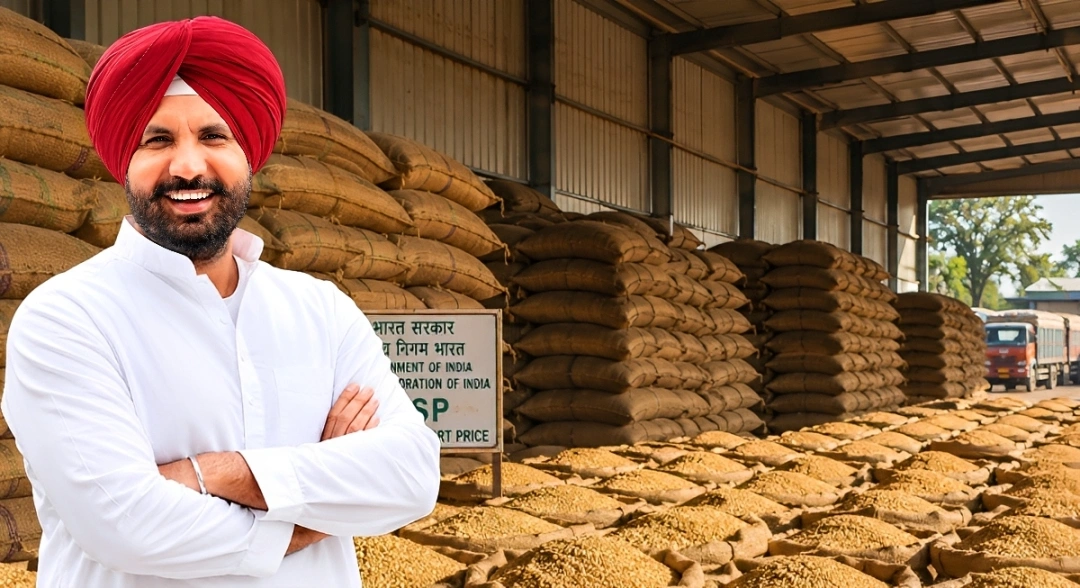
MSP is the price floor the government sets annually for 23 crops - but it has no legal backing. Punjab is unique in that 100% of its farmers sell crops at MSP through government procurement. Since 2020, farmers have demanded this be made a statutory right at C2+50% per the Swaminathan Commission formula. In February 2024, protests resumed at Shambhu and Khanauri borders - with farmer leader Dallewal going on an indefinite fast. Over 700 farmers died during these agitations. The government has not enacted the law. Raja Warring raised this in the Lok Sabha in March 2026 and was among Congress MPs present when Rahul Gandhi met farmer leaders in Parliament in 2024. Current MSP Punjab 2026 rates: Wheat ₹2,425/quintal, Common Paddy ₹2,300/quintal.
Punjab's farmers have been asking the same question for years: why is the minimum support price not protected by law?
It is a question that has been raised on protest grounds, in Parliament, in court, and at the cost of extraordinary human suffering. As of 2026, more than 700 farmers died during the protests demanding a legal MSP guarantee - a number that makes the absence of legislation not merely a policy failure, but a moral one. Yet the law does not exist. The Punjab farmers MSP fight continues.
What Is MSP and Why Does It Matter for Punjab?
The Minimum Support Price is a price floor set annually by the Union Government for 23 agricultural commodities, based on the recommendations of the Commission for Agricultural Costs and Prices (CACP). For Punjab's farmers, the MSP is not an abstraction - it is the number on which the entire paddy-wheat crop cycle rests.
Punjab is one of the only states in India where 100 per cent of farmers sell their wheat and paddy at MSP through government procurement agencies - primarily the Food Corporation of India (FCI) and state agencies. In the kharif procurement season, for example, Punjab contributes more wheat to national stocks than any other state. The paddy procurement Punjab MSP system has been the backbone of the Green Revolution's legacy and the primary source of income stability for millions of Punjabi farming households.
But MSP Punjab 2026 is not a legal right. It is an executive decision - announced annually by the Union Cabinet, subject to revision, and entirely at the discretion of the government in power. Farmers receive it when the government chooses to procure and at the price the government sets. There is no law that compels any government to buy crops at MSP or guarantees farmers that the price will be set at a particular level.
This is the gap at the heart of the Punjab farmers MSP crisis. And it is why the demand for a legal guarantee - backed by the Swaminathan Commission formula of MSP at minimum 50 per cent above the comprehensive cost of production (C2) - has driven farmer protests for over a decade.
The 2024 Farm Protests - What Happened and What It Cost
In February 2024, thousands of farmers from Punjab and Haryana resumed their march toward Delhi at the Shambhu and Khanauri border points - pressing a set of demands anchored by the legal MSP guarantee India that the Union Government had promised but not delivered following the repeal of the three farm laws in November 2021.
The protests involved farmer unions under the Samyukta Kisan Morcha (Non-Political) and the Kisan Mazdoor Morcha. Farmer leader Jagjit Singh Dallewal began an indefinite fast-unto-death at Khanauri on 26 November 2024, drawing national and international attention to the cause.
The costs were staggering. Over 700 farmers died during the course of the protests - from medical emergencies, road accidents, extreme weather exposure, and health deterioration during the prolonged agitation. Dallewal's fast brought him to the edge of medical crisis before the Supreme Court intervened to ensure he received medical attention.
The central government entered into multiple rounds of talks with farmer leaders at the MGIPA in Chandigarh - but the talks remained inconclusive. The government expressed concerns about implementation feasibility of a legal MSP guarantee India, sought further deliberations, and did not commit to legislation.
Raja Warring and the Congress Position - Kisan Nyay Congress MSP
The Indian National Congress committed, in its 2024 Lok Sabha election manifesto, to enacting a legal guarantee for MSP at C2+50 per cent as part of its Kisan Nyay Congress MSP platform. This position - framed within the broader Kisan Nyay (Farmers' Justice) framework that also covers farm loan guarantees, crop insurance, and crop diversification support - represents the most specific legislative commitment any major national party has made on the MSP question.
Amarinder Singh Raja Warring has consistently championed this position in Parliament and in public. In March 2026, during the Budget Session of the 18th Lok Sabha, Warring raised the demand for a legal MSP guarantee directly on the floor of the House - questioning why the legal protection had not been granted even after more than 700 farmers had died during protests demanding it. He also raised the issue of Punjab farmers being excluded from crop insurance schemes amid the growing climate crisis, and demanded a ₹500 crore corpus fund for Punjab Agricultural University to strengthen agricultural research.
Warring was also among the senior Congress MPs present when Rahul Gandhi met farmer leaders during the 2024 Monsoon Session of Parliament - a meeting of Samyukta Kisan Morcha leaders from Punjab, Haryana, Uttar Pradesh, Telangana, Tamil Nadu, and Karnataka. Congress's commitment to press the government on legal MSP was reaffirmed at that meeting.
His participation in the Demands for Grants debate for the Ministry of Agriculture and Farmers Welfare on 12 March 2025 - one of his 18 verified debates in the 18th Lok Sabha as recorded by PRS India - further reflects the centrality of farmers' welfare to his parliamentary work as Ludhiana MP.
MSP Punjab 2026 - What the Current Rates Are
For the 2025–26 kharif and rabi marketing seasons, the Union Government has announced the following MSP Punjab 2026 rates for key crops grown in Punjab:
- Paddy (Common): ₹2,300 per quintal
- Paddy (Grade A): ₹2,320 per quintal
- Wheat: ₹2,425 per quintal
- Maize: ₹2,090 per quintal
- Cotton (Medium Staple): ₹7,121 per quintal
- Cotton (Long Staple): ₹7,521 per quintal
While these rates represent incremental increases from the previous year, farmer organisations argue that the C2+50 per cent Swaminathan formula would yield significantly higher prices - particularly for paddy, where the gap between the current MSP and the formula-derived price is estimated at several hundred rupees per quintal.
The paddy procurement Punjab MSP system also faces a structural challenge that no price increase alone can solve: over-dependence on the paddy-wheat crop cycle has led to severe groundwater depletion - particularly in the Malwa and Doaba belts - as tube well-irrigated paddy cultivation continues at unsustainable scale. Crop diversification toward less water-intensive crops like maize, pulses, and oilseeds is a stated government priority, but Punjab Agricultural University and independent economists agree that diversification will not happen at scale without a guaranteed MSP for alternative crops - the same argument at the heart of the farmers' protest Punjab.
What Needs to Happen Next
The legal MSP guarantee India debate involves genuine policy complexity. Economists have noted that a blanket statutory MSP across all 23 crops could have significant fiscal implications and potential market distortions. The government has consistently cited these concerns as reasons for caution.
But the Congress position - and Warring's position - is that these complexities do not justify indefinite delay. The Swaminathan Commission submitted its report in 2006. The Union Government's own committee on MSP, formed as a condition of ending the 2020–21 farm protests, has not delivered a definitive framework. In the meantime, Punjab's farmers - who feed the nation's buffer stocks and have done so for six decades - continue to work without the legal protection of a guaranteed floor price.
The fight for Punjab farmers MSP is not over. It is being waged on protest grounds, in Parliament, and through the political process - and it will continue to define Punjab politics through 2026 and into the 2027 assembly elections.
Read more about Raja Warring'sparliamentary record and work, hismajor campaigns, and theCongress political journey. Visit thearticles section for more updates on Punjab's key issues.
Join the Movement
More than 700 farmers died demanding a law. Not a scheme. Not a promise. A law - the kind that cannot be withdrawn by executive order, that would protect every farmer regardless of which government is in power.
Raja Warring has taken this demand to Parliament, to public platforms, and to every farmer he has met across Punjab. The fight for legal MSP is a fight for the dignity of every family that feeds this nation. If you believe Punjab's farmers deserve justice - stand with the movement.