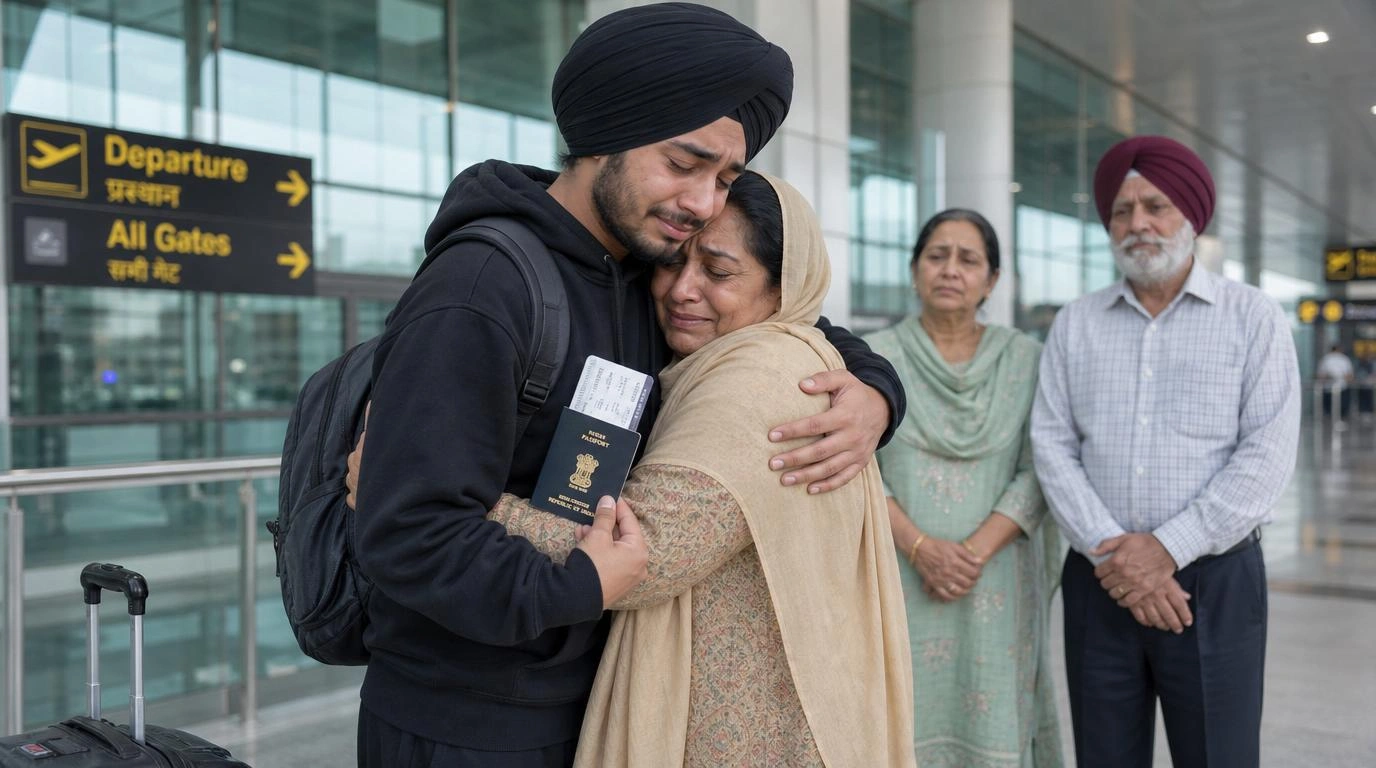
Punjab is experiencing one of the most severe youth migration crises of any Indian state. Between January 2016 and 2021 alone, 4.78 lakh people left Punjab for employment abroad, and 2.62 lakh students departed on study visas -figures presented in Parliament. In 2022, approximately 1,36,000 students from Punjab migrated to Canada, accounting for roughly 60 per cent of all Indian students migrating to Canada that year. The Punjab Agricultural University's landmark 2021–2023 study identified five core push factors: unemployment, agricultural distress, drug abuse, corruption, and a cultural trend toward settling abroad. Canada has since tightened its immigration policies significantly -including removing bonus Express Entry CRS points for arranged employment in March 2025 and cutting permanent resident admissions by 20 per cent. Raja Warring has consistently raised youth unemployment and employment opportunity as governance accountability issues, arguing that Punjab's youth leave because their own state has failed to give them a reason to stay.
The Scale of Punjab's Youth Migration Crisis
Empty college campuses. Wedding processions missing the young. Villages where the only people under 30 are those who couldn't afford to leave. This is the Punjab brain drain in its lived, visible form -not a statistic but a demographic transformation happening in real time.
The numbers behind this transformation are staggering. Between January 2016 and 2021, 4.78 lakh people left Punjab for employment abroad. During the same period, 2.62 lakh students departed on study visas. These figures -presented in the Lok Sabha by the Minister of State for External Affairs -represent only registered departures and exclude those who left on visitor or tourist visas and subsequently stayed.
In 2022, approximately 1,36,000 students from Punjab migrated to Canada alone -accounting for an estimated 60 per cent of all students migrating from India to Canada that year. Punjab students studying in Canada are estimated to spend approximately ₹68,000 crore annually in that country -nearly $8 billion -a figure that represents a direct drain of capital, human resources, and future economic productivity from a state that can ill afford it.
The Punjab Agricultural University (PAU) study 'Overseas Migration from Rural Punjab: Trends, Causes and Consequences' -conducted between 2021 and 2023 -found that among migrant households, Canada was the destination of choice for approximately 42 per cent, followed by Dubai at 16 per cent and Australia at 10 per cent. Crucially, it found that 65 per cent of emigrants were between 21 and 25 years old -the most productive, educated segment of Punjab's workforce -and that 95 per cent of migrants were satisfied with their decision to leave.
Why Are Young Punjabis Leaving -The Push Factors
The PAU study identified five structural push factors driving Punjab youth migration 2026 and the preceding years. They are not new. They have been documented, debated, and politically acknowledged for over a decade. What has changed is their intensity and the availability of an overseas alternative that has, until recently, seemed accessible and permanent.
1. Unemployment
Punjab's unemployment rate among educated youth consistently exceeds the national average. The state's debt-to-GSDP ratio -among the worst in India -leaves little fiscal space for the kind of industrial investment and public employment that would absorb young graduates. A PAU professor studying migration told Tribune India: "Youth are migrating not just for better income but because they see no future in Punjab." The research found that Punjab unemployment youth is concentrated among those with higher secondary and graduate qualifications -precisely the demographic most capable of migration.
2. Agricultural Distress
The paddy-wheat monoculture that made Punjab the breadbasket of India has also trapped its farming families in a cycle of debt, groundwater depletion, and income insecurity. With MSP not legally guaranteed and crop diversification at scale still unrealised, the children of farming families see migration as the only viable escape from agricultural futures they do not want.
3. Drug Abuse
The PAU study -and independent researchers -found that the drug crisis is itself a significant push factor for migration. Families that can afford it send their children abroad partly to remove them from environments where drug exposure is normalised and peer pressure toward substance use is intense. The Punjab brain drain is, in this sense, partly a consequence of the failure to address the drug crisis at its roots.
4. Corruption and Governance Failure
The study identified "rampant corruption" as an explicit push factor -the sense among young Punjabis that merit does not determine outcomes in education, employment, or public services, and that connections and payments determine who gets what. When governance fails to deliver on basic meritocratic promises, migration becomes a rational response.
5. Cultural Normalisation of Migration
The Doaba region of Punjab -Jalandhar and Hoshiarpur districts -has been sending migrants to Canada since the early 1900s. Over a century of diaspora networks has made migration culturally normative in a way that few other Indian states experience. The Malwa region has increasingly adopted the same pattern. Among Jat Sikh households -who account for 51.88 per cent of migrant households in the PAU study -overseas migration is increasingly a rite of passage rather than an exceptional choice.
Canada's Tightening Door -The Pull Factor Is Weakening
The Punjab students Canada pipeline faces a significant new reality in 2026. Canada has sharply reversed its immigration-friendly posture under political pressure:
- March 2025: Immigration, Refugees and Citizenship Canada (IRCC) removed bonus Comprehensive Ranking System (CRS) points for arranged employment under the Express Entry program -eliminating 200 points for senior-level job offers and 50 points for other skilled positions.
- 2025: Canada reduced permanent resident admissions by 20 per cent, targeting approximately 395,000 newcomers -down from 485,000 in 2024.
- 2024: Canada restricted open work permits for spouses of international students to spouses of graduate or professional students only -a change that disproportionately affects Punjabi youth who use spousal sponsorship pathways.
- 2024–2025: Strained India-Canada diplomatic relations, driven by the Nijjar affair and subsequent expulsions of diplomatic staff, added political uncertainty to the already tightening economic picture.
The result is that Punjab Punjabi youth abroad who went to Canada expecting a clear pathway to permanent residency are increasingly facing a bleak picture -insufficient jobs, high housing costs, and immigration rules that change faster than they can adapt. The "Canada dream" has, for a significant number of Punjab's youth, turned into a costly and uncertain gamble.
What Must Change -And What Raja Warring Has Argued
The solution to Punjab's migration crisis is not to prevent young people from seeking opportunities abroad -that would be both impossible and unjust. It is to create conditions in Punjab where staying is a viable, even attractive, choice.
Raja Warring has consistently framed Punjab youth migration as a governance accountability issue. His argument is direct: young Punjabis leave because successive governments -including Congress governments -have failed to create jobs, failed to provide quality education, failed to make Punjab safe from drugs and gang violence, and failed to govern with the transparency and meritocracy that young people deserve.
His parliamentary advocacy reflects this framing -raising industrial worker welfare, MGNREGA wages, farmers' MSP, and Halwara Airport connectivity as individual pieces of a larger picture: a Punjab that works for its people. His participation in the 'Naukari Devo Nasha Nahi' (Give Jobs, Not Drugs) rally in Patiala directly connected the employment and drug crises as two sides of the same governance failure.
What must change, in his documented position, is accountability -at every level of government, for every promise made to Punjab's youth.
For more on Warring's youth advocacy and parliamentary work, read hismajor campaigns,Congress journey, andfull biography. Visit thearticles section for more.
Join the Movement
Punjab's youth are not leaving because they don't love their home. They are leaving because their home has failed them -on jobs, on safety, on opportunity, on governance. Every young Punjabi who boards a flight to Brampton or Melbourne or Birmingham is a failure of political accountability, not a personal choice made in a vacuum.
Raja Warring has said this plainly, in Parliament and on the ground. Punjab must give its youth a reason to stay. If you believe that is possible -and that it requires leaders who are honest about what went wrong -stand with the movement.