Imagine travelling to a protest to demand fair prices for your crops, only to face barricades, police restrictions and uncertainty about what might happen next. If you are stopped or detained far from home, knowing where to seek legal help can become an urgent concern — for you and your family.
This was the backdrop to the Delhi Chalo farmers’ march in February 2024. As farmers approached the Haryana borders on their way to Delhi, the confrontation raised questions about their demands, their right to protest and the assistance available to those facing legal difficulties.
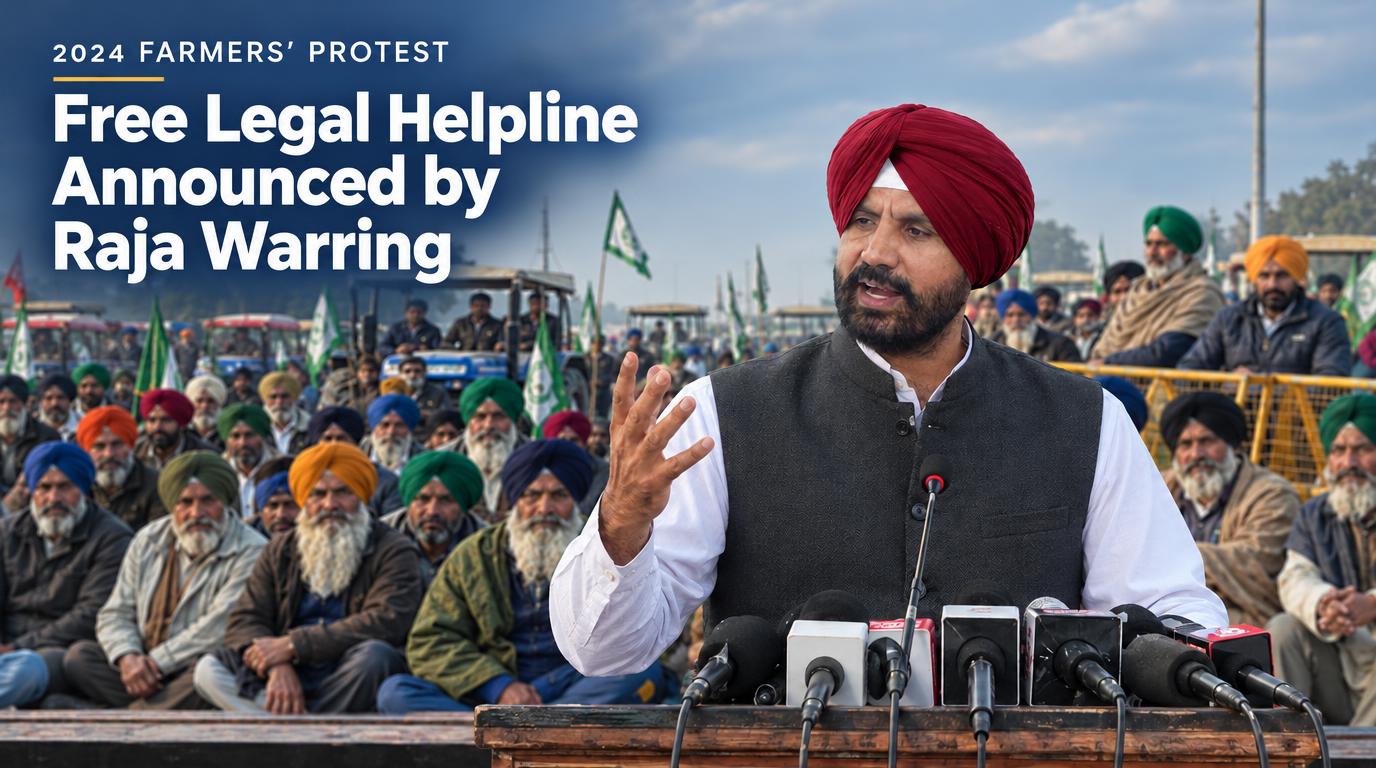
On February 13, 2024, Amarinder Singh Raja Warring, then President of the Punjab Pradesh Congress Committee (PPCC), announced a free, 24/7 legal aid helpline for protesting farmers. The number was 82838-35469, offering a dedicated point of contact for farmers seeking legal assistance during the agitation.
The helpline was intended as a temporary support service for the immediate legal concerns arising during the Delhi Chalo protest. It is no longer active today, but its announcement remains part of the record of the support offered to farmers during the February 2024 agitation.
Punjab Farmers Legal Helpline: What Was Announced?
The helpline was announced at Punjab Congress Bhawan in Chandigarh. Raja Warring said the Punjab Congress legal team would provide complimentary legal assistance to farmers participating in the protest.
Advocate Bipan Ghai, Chairman of the Punjab Congress Legal Cell, and PCC Chief Spokesperson Advocate Arshpreet Singh Khadial were among those present at the press conference.
The initiative addressed a practical concern. For a farmer involved in a protest, or a family member worried about a possible detention or legal case, access to legal guidance can make a difficult situation easier to navigate.
The announcement gave the party’s stated support a specific form: a telephone number through which protesting farmers could seek free legal assistance, around the clock.
Why Raja Warring Criticised the Border Barricades
For Raja Warring, the issue extended beyond access to Delhi. He strongly criticised the barricades erected at the Haryana borders and the reported use of tear gas and water cannons against protesting farmers.
He argued that farmers raising their demands peacefully should not be treated as a threat. Comparing the border restrictions with the arrangements at the Indo-Pak border, he questioned why such barriers were being imposed on citizens seeking to make their voices heard.
His criticism also extended to the BJP-led Centre and what he described as its failure to fulfil earlier commitments to farmers.
The point was central to his position during the protest: farmers’ demands required a response, not simply a security-heavy approach to containing their march.
Supporting Farmers Without Taking Over Their Movement
The farmers’ agitation was being led by farmer unions, some of which had made clear that they did not want political parties using the protest for direct political endorsements.
Raja Warring acknowledged this position while maintaining that assistance should remain available to farmers who needed it.
The distinction matters. A farmer’s need for legal help does not depend on political allegiance, nor does accepting assistance mean endorsing a political party. The helpline was presented as a way to support farmers while respecting the independent character of their movement.
That approach placed the immediate needs of protesting farmers at the centre of the announcement, without making political endorsement a condition of support.
The Six Demands Raja Warring Highlighted
The legal aid initiative addressed one immediate concern, but the protest was driven by wider questions about agricultural income, debt and farmers’ rights.
At the February 13 press conference, Raja Warring highlighted six demands:
- A legal guarantee for Minimum Support Price (MSP) to provide greater certainty over the prices farmers receive for their produce.
- MSP based on Swaminathan Commission recommendations, a longstanding demand concerning agricultural production costs and farmers’ returns.
- A farm loan waiver to provide relief from agricultural debt.
- Compensation for families of farmers who died during the earlier protest.
- Implementation of the 2013 land acquisition legislation, subject to verification of the precise terminology used in the original press conference.
- Withdrawal of FIRs registered during the earlier farmers’ protest.
These demands reflected concerns affecting farmers’ livelihoods, financial security and treatment during earlier demonstrations. For households facing rising costs or outstanding loans, questions about MSP and debt relief have direct consequences for their ability to sustain farming.
Why Farm Debt Was Part of the Debate
During the press conference, Warring cited approximately ₹75,000 crore in debt among Punjab’s farmers, involving around 24.92 lakh farmers. He also referred to the ₹72,000 crore farm loan waiver announced under the UPA government led by Dr Manmohan Singh and a ₹4,640 crore waiver implemented by an earlier Congress government in Punjab.
These figures are attributed to Warring’s statements at the time.
Farm debt was an important part of the wider discussion because agricultural households must manage production costs and financial uncertainty, often before knowing what income their crops will generate. The demand for debt relief therefore sat alongside MSP and other measures being sought by the protesting farmers.
Legal Aid and the Right to Be Heard
The February 2024 helpline was a specific initiative announced during a much wider farmers’ agitation. It did not resolve the policy questions behind the protest, but it established a channel for seeking legal assistance during a period of confrontation and uncertainty.
The episode brought together two concerns: the immediate need for legal guidance and the larger demands farmers were raising before the government. Both formed part of the debate over farmers’ rights, agricultural security and the treatment of peaceful protesters.
For Raja Warring, then leading the Punjab Congress, the announcement placed practical legal assistance alongside his criticism of the restrictions imposed on the march and his support for the demands being raised by farmers.
The wider questions remain significant for Punjab’s agricultural future: how can farmers secure fair returns, manage debt and ensure that their concerns receive a meaningful response?
These issues continue to shape discussions about agricultural policy and the future of farming in the state.
To learn more about Raja Warring’s work beyond this intervention, read about the82 questions he raised and 18 debates in the 18th Lok Sabha. You can also explore hispolitical journey with the Congress and browse more of his public interventions and issues concerning Punjab in thearticles section.
Join the Movement
Farmers’ rights, fair prices, and access to justice are important to Punjab’s future. When citizens raise concerns, question decisions, and demand accountability, they help bring public issues into the wider conversation.
Whether your concern is agriculture, employment, drug abuse, law and order, or the policies shaping Punjab, staying informed and speaking up matters.
Be part of a community that values informed debate, responsible leadership, and accountability in public life. Stay engaged, raise your voice, and help shape the conversation about Punjab’s future.