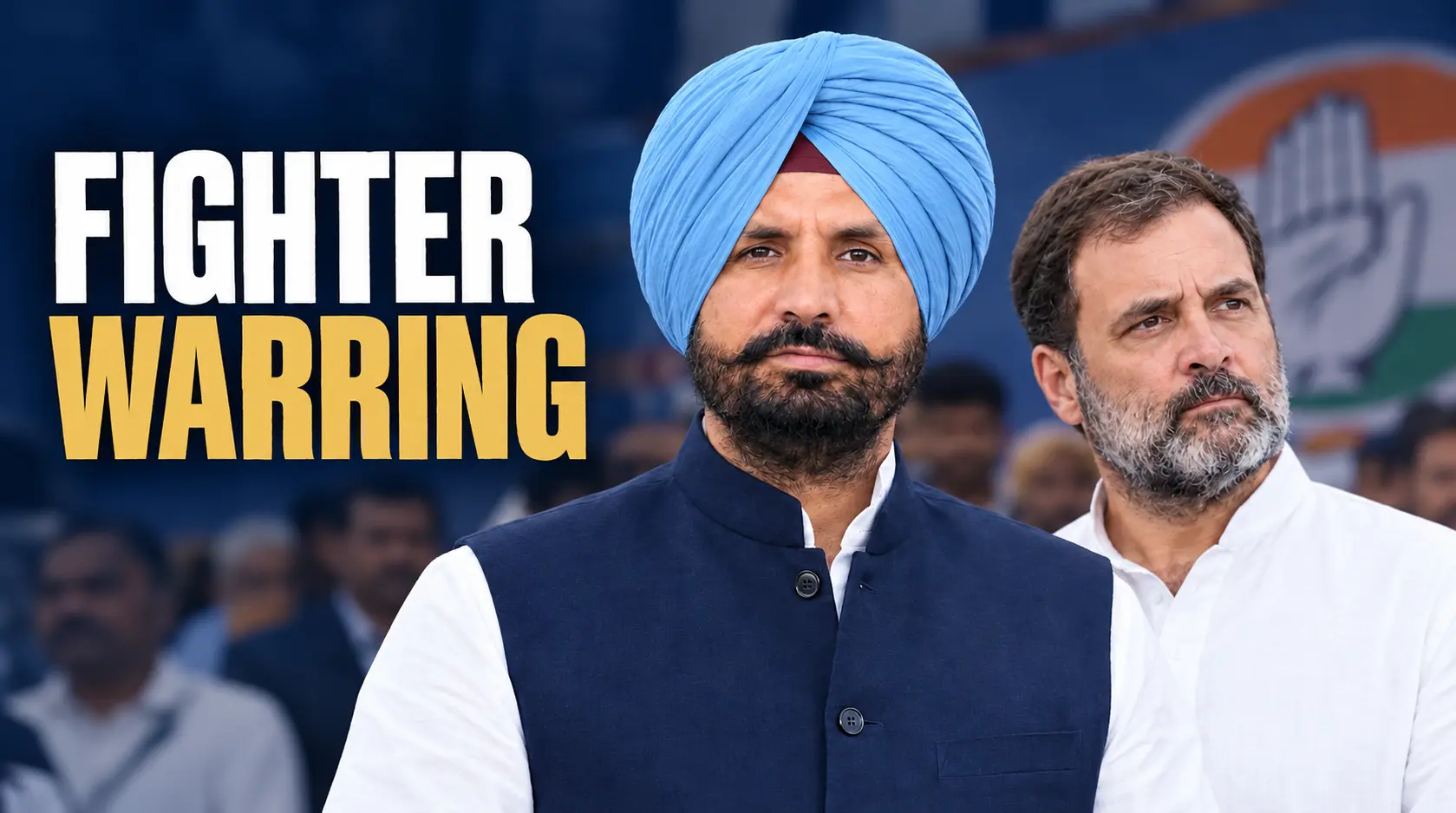
On 2 October 2026, Raja Warring sat down with Rahul Gandhi in Delhi and formally handed in his resignation as president of the Punjab Pradesh Congress Committee. It was the end of a journey that had lasted four and a half years, from 9 April 2022 to that day.
A day earlier, he had quietly changed one line on his X profile. It now read “Former PPCC President”. It was a small edit on a screen, but for the workers who had followed him through village rallies, police barricades and water cannons, it marked the end of an era.
But the story of that day does not begin in Delhi. It begins four and a half years earlier, with a party that was almost finished, and a man who was handed the job nobody else wanted.
April 2022: How Raja Warring Became Punjab Congress President
Picture Punjab in April 2022. The Congress had just lost power and been cut down to 18 seats. In village after village, the party office stood shut.
Workers who had once walked proudly behind the flag now had no one to walk with. And the leaders, instead of standing together, were fighting each other in public.
Someone had to take the burning chair. The party turned to a man from Gidderbaha: three times an MLA, a former national president of the Indian Youth Congress, a leader who had learned politics the hard way, among young workers, with slogans and sweat. Bhupesh Baghel would later say that Rahul Gandhi handed him the command when the party had fallen from 80 seats to 18.
On 9 April 2022, Raja Warring became the president of the Punjab Pradesh Congress Committee. He had inherited a house with the roof gone.
One Empty Chair at a Time
His first battle had no cameras. Block president posts were empty. District posts were empty. A party cannot stand when its limbs are missing, so he went looking for them. He travelled through rural Punjab, Malwa above all, to find the workers the party had forgotten and ask them to come back. One chair at a time.
Then came the bruises. Sangrur, 2022: lost. Jalandhar, 2023: lost. These are defeats that make a weaker leader step back. Warring read them differently. Every loss was a map, showing him exactly where the roots had dried up and where tomorrow’s work lay.
In January 2023, Rahul Gandhi’s Bharat Jodo Yatra reached Punjab, and the state unit faced its first real exam. Crowds, security, a hundred things that could go wrong. Warring carried it through as state chief. Quietly, the party began to believe in itself again.
On the Streets: Every Dharna, Every Water Cannon
Then he did something that changed how the workers saw their president. He stopped sending them to the front line. He went himself.
Dharna after dharna, march after march, Warring took the Congress out of its offices and onto the roads. He fought the AAP government on Punjab’s streets. And when the Congress fought its national battles, he made sure Punjab stood with Rahul Gandhi.
The early years: 2022 and 2023
June 2022, Chandigarh. Just two months into the job, he led hundreds of workers on a march from Punjab Congress Bhawan against the Enforcement Directorate’s repeated questioning of Rahul Gandhi. Water cannons met them, and the leaders were taken to the Sector 3 police station.
October 2022, Patiala. He sat on a dharna demanding action against Cabinet Minister Fauja Singh Sarari after an audio clip controversy.
March 2023, Chandigarh. He led Congress workers to gherao the Punjab Raj Bhavan over the Adani issue. The police used water cannons and detained him. The same month, he announced a gherao of the Vidhan Sabha on the ₹1,000 a month promised to women. And on 26 March, after Rahul Gandhi’s disqualification from the Lok Sabha, the Punjab and Haryana Congress held a day-long Sankalp Satyagraha in Chandigarh, where Warring said the Centre was scared of Rahul Gandhi’s next speech on the Adani issue.
August 2023, Mohali. When the government dissolved all panchayats before their term, he led a state-level dharna outside the Director Panchayat’s office. The Congress also took the decision to the High Court.
September 2023, Abohar and Hoshiarpur. He led a series of anti-drug dharnas against the Mann government, saying the protests would continue across the state until the government acted to save the youth.
Inside the House and out: 2024 and 2025
March 2024, the Vidhan Sabha floor. When the Speaker refused him more time to speak on the state budget, Warring refused to leave the House and sat down on the floor. The Assembly marshals lifted him out.
June 2024. He was detained during a protest demanding a Supreme Court-monitored probe into the NEET-UG irregularities.
March 2025, the Vidhan Sabha. He led the march to the Assembly on the women’s ₹1,000 promise. Water cannons soaked the road, the police detained him, and the pictures travelled across Punjab.
July 2025, Ludhiana and Mohali. When the AAP government announced its land pooling policy, Warring arrived at a sit-in outside the GLADA office in Ludhiana on a tractor. On 21 July, he led the dharna outside the GMADA office in Mohali with Partap Singh Bajwa and launched a statewide agitation, calling the policy “land looting”.
The last year: 2026
January to February, MGNREGA. When the Centre replaced MGNREGA with the VB-G RAM G Act, Warring called it an insult to Mahatma Gandhi’s legacy. On 8 January, the Punjab Congress launched the “MGNREGA Bachao Sangram” at rallies in Gurdaspur and Tanda in Hoshiarpur. On 28 February, Rahul Gandhi and Mallikarjun Kharge were due to address the Congress’s kisan-mazdoor rally in Barnala, which the party used to open its 2027 campaign.
July, Khanna and Delhi. When the police used batons, tear gas and water cannons on MGNREGA workers protesting in Khanna on 15 July, Warring demanded that the officers responsible be suspended. Six days later, he joined Rahul Gandhi’s march near the Prime Minister’s residence in Delhi, standing with students over the NEET paper leak and demanding the Education Minister’s resignation. Police removed the protesters from the site. Four days after that, the Education Minister, Dharmendra Pradhan, resigned.
September, the final month. Even in his last month as president, he was still on the road.
- 8 September. The party held a major protest against the Mann government on drugs and law and order. Workers burnt the Chief Minister’s effigy outside Punjab Congress Bhawan, and when they tried to march to his residence, the police used water cannons repeatedly. All 25 district Congress presidents joined.
- 14 September. He led workers to the power corporation headquarters in Patiala over prolonged power cuts. The police used water cannons and detained him.
- 15 September. He marched in Chandigarh with Sachin Pilot and Partap Singh Bajwa, demanding the dismissal of Finance Minister Harpal Singh Cheema over the death of a Dalit villager in Sangrur. The police detained the leaders there as well.
- 25 September. As the Congress launched a nationwide agitation demanding the resignation of Chief Election Commissioner Gyanesh Kumar, Warring led the Punjab march towards the Election Commission office in Chandigarh. Water cannons met the workers again.
- 28 September. Three days later, he led hundreds of workers outside the District Administrative Complex in Ferozepur, where they burnt effigies of the Prime Minister and the Chief Election Commissioner.
Then came the day that said it all. Four days after he handed in his resignation, on 6 October, Warring was back on the road, this time in Delhi. He marched from Parliament towards the Election Commission office with Rahul Gandhi, Priyanka Gandhi Vadra and other INDIA bloc MPs, demanding Gyanesh Kumar’s resignation. Police stopped the march near Akashvani Bhavan and detained the leaders, Warring among them. Afterwards, he said the police had treated MPs “as if we were criminals”.
A party of tired workers had seen its own president standing in the same drenched line as them. That was when the fear began to leave. They began calling him the Brahmastra, the weapon you bring out when every other weapon has failed. They called him the engine that keeps moving even when its tyres are punctured.
The Road to Ludhiana: Seven Seats and a Comeback
In 2024, Warring made the boldest move of his career. The Punjab Congress, under his leadership, opposed any tie-up or seat-sharing with the AAP in the state and went to the polls on its own. As the campaign gathered pace, former minister Malkit Singh Birmi and former MLA Luv Kumar Goldy rejoined the party. Warring himself left Gidderbaha, the seat he had won three times, and chose the Lok Sabha seat of Ludhiana, against Ravneet Singh Bittu, a heavyweight who had walked out of the Congress and into the BJP.
It was a fierce fight. Warring won. And across Punjab, the Congress won 7 of the state’s 13 seats. The party that had been written off two years earlier was back in the fight.
Raja Warring’s Achievements as Punjab Congress President
- Rebuilt the organisation. He filled vacant block and district posts, and by September 2026, all 25 district Congress presidents were standing with him on the streets.
- Brought the Congress back as the main challenger. The party won 7 of Punjab’s 13 Lok Sabha seats in 2024, and he won Ludhiana himself.
- Delivered the Punjab leg of the Bharat Jodo Yatra in January 2023.
- Took the fight to the streets. From Patiala to Chandigarh, he faced water cannons and detention for farmers, women, youth and the power-hit citizen.
- Kept the Congress independent. He opposed any alliance with AAP in Punjab and rebuilt the party’s own space.
- Brought leaders back. Former minister Malkit Singh Birmi and former MLA Luv Kumar Goldy rejoined during his tenure.
- Kept the party in the race in the 2026 civic polls, where the Congress finished as the AAP’s main challenger.
- Opened the doors to women. In April 2026, he announced that the Punjab Congress would give women 33% of its tickets in the 2027 Assembly elections.
The Last Chapter: Why Raja Warring Stepped Down as Punjab Congress President
But every long road has a final bend. On 1 July 2026, the party kept Warring as president and named Charanjit Singh Channi to lead its campaign committee, hoping two strong leaders could pull in one direction. Some in the party were not convinced, and the differences did not go away.
On 3 August, in Bathinda, Warring was asked if he would resign. He said no. If the party wanted a change, he would keep working anyway. He would rather retire than leave the Congress, he said, and Raja Warring could die, but would never compromise with the BJP.
Then, in September, Sachin Pilot arrived as the party’s in-charge for Punjab, met leaders and workers, and carried his findings to the high command.
With the 2027 elections only months away, the party wanted a fresh start. Warring said the decision to step aside was his own. Whatever the full story, he did not cling to the chair. On 2 October, he went to Delhi.
A Goodbye With No Bitterness
A leader who has just left his chair could be forgiven for staying away from his successor’s ceremony. Warring came. At the handover in Chandigarh, he stood beside Pargat Singh, the MLA and former captain of the Indian hockey team, and promised him his full support.
Behind them on the stage stood Charanjit Singh Channi, Manish Tewari, Sukhjinder Singh Randhawa and Rajinder Kaur Bhattal, the biggest names in the Punjab Congress, a quiet message that Warring remained a pillar of the party’s future.
Then Warring spoke to his workers, and his voice was not that of a man who was leaving. “No one stays at the top forever... But I will remain available whenever the Congress needs me. I am a worker who does not back down.”
Hundreds of district presidents and loyal leaders also gathered at his residence in a parallel show of strength, a sign that while he no longer held the title, he was still the emotional anchor for a generation of Congress workers.
What Leaders and Workers Said About Raja Warring
Even Sachin Pilot, who had carried out the change, did not hide his respect. He called Warring a “fighter” and a “soldier” of the Congress, and said: “He’s a very, very energetic, hardworking young man. And he has actually helped build the Congress party at a time when we had only 15-16 MLAs.”
Partap Singh Bajwa, the Leader of the Opposition, who had fought beside him in the Assembly, said it plainly: “Raja ji has done an excellent job.”
The workers said it in their own way. One recalled that there was a time when the Congress could not gather even 200 people for a dharna in Ropar, and that today more than 20,000 come out. Another said, “There was fear inside the party, and Raja Warring made it vanish.” A third said he held rallies, faced water cannons and lathi charges, and fought on every front, and called him a Brahmastra, the one who comes into play when every other weapon fails. Another remembered that in 2022 the party lay scattered, and that he revived its spirit and won seven Lok Sabha seats in 2024. And one said simply, “Sons are born into every family, but a son like Raja Warring is rare.
The Story Is Not Over
Raja Warring took over a defeated, silent party in 2022. Four and a half years later, he hands over an organisation that is alive in the villages, competitive at the ballot box, and holds a majority of the state’s Lok Sabha seats.
He is still the Member of Parliament from Ludhiana. And somewhere in Punjab, a worker who once feared the barricades is standing a little taller, because he watched his president stand in front of him.
Join the Movement
Punjab’s future depends on citizens who stay informed, question the decisions that affect their lives, and demand accountability from those in power.
Whether your concern is employment, agriculture, drug abuse, law and order, or the direction of Punjab’s politics, your voice matters in shaping the state’s future.
Join a growing community of citizens who believe in informed debate, responsible leadership, and a better future for Punjab. Stay engaged, speak up, and be part of the conversation that moves Punjab forward.