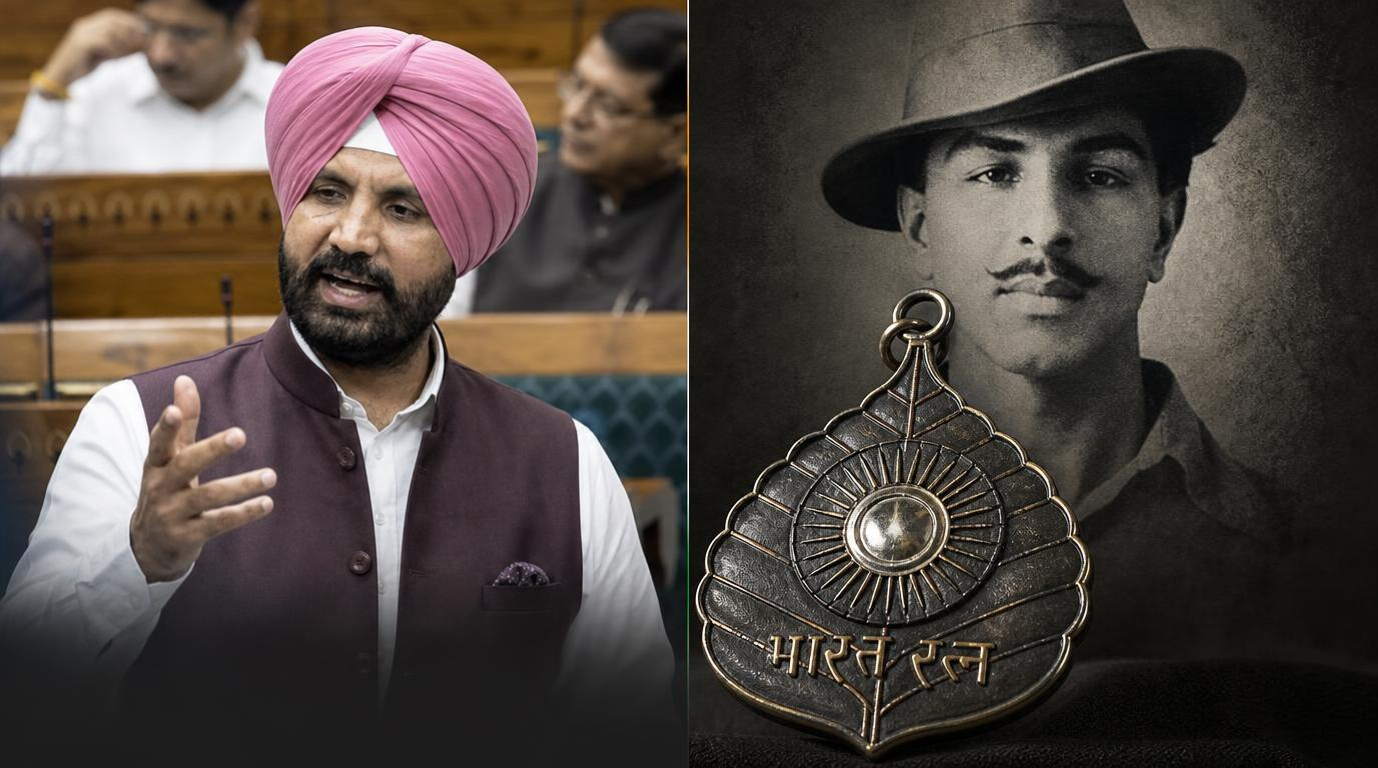
Some names in India's history rise above politics, governments and generations. Shaheed Bhagat Singh is one of them.
Nearly a century after his sacrifice, Bhagat Singh remains one of India's most admired revolutionaries. On 23 March 1931, Bhagat Singh was executed by the British along with his fellow revolutionaries Shivaram Rajguru and Sukhdev Thapar. The sacrifice of Bhagat Singh, Rajguru and Sukhdev became one of the most enduring symbols of India's freedom struggle.
Bhagat Singh's courage, political thought and commitment to India's freedom continue to inspire generations of Indians, particularly the country's youth. His legacy has endured far beyond the era in which he lived, making him one of the most recognisable figures of India's struggle for independence.
Yet Bhagat Singh has never been conferred the Bharat Ratna, India's highest civilian award. This is the question that Ludhiana Member of Parliament and Punjab Congress President Amarinder Singh Raja Warring chose to raise in Parliament.
On 3 April 2025, Raja Warring raised the demand in the Lok Sabha through a Special Mention during Zero Hour, calling for Bharat Ratna for Shaheed Bhagat Singh and urging the Government of India to officially accord him the status of a martyr. The parliamentary record identifies the matter as the need to confer Bharat Ratna on Shaheed Sardar Bhagat Singh.
For Raja Warring, the demand was not simply about a national award. It was about how India formally remembers and recognises those who made the ultimate sacrifice during the freedom struggle.
Why Bharat Ratna for Bhagat Singh Matters
Bhagat Singh's place in India's freedom struggle goes far beyond his age or the circumstances of his death. He became a powerful symbol of resistance to colonial rule and left behind writings and ideas that continue to be discussed decades after his martyrdom.
He was only 23 when he was executed by the British in 1931, but his influence has extended across generations and geographical boundaries. From Punjab to the rest of India, Shaheed Bhagat Singh remains deeply embedded in the country's public memory.
The Bharat Ratna was instituted by the Government of India in January 2, 1954 and is described by the government as the country's highest civilian award. It recognises exceptional service or performance of the highest order in any field of human endeavour.
This historical timing is important. Bhagat Singh was martyred in 1931, more than two decades before the Bharat Ratna was instituted. The award can also be conferred posthumously under its rules.
It is against this background that the demand for Bharat Ratna for Bhagat Singh continues to be raised: as a call to give India's highest civilian recognition to one of the most enduring figures of its freedom movement.
Raja Warring Raises the Bharat Ratna Demand for Bhagat Singh in Parliament
On 3 April 2025, Raja Warring raised the issue of Bhagat Singh in the Lok Sabha, making the demand for both Bharat Ratna and formal martyr status part of the parliamentary record.
In his intervention, Warring highlighted the extraordinary respect Bhagat Singh continues to receive across India and his enduring influence on the country's youth. Contemporary reports of the intervention also recorded Warring's argument that Bhagat Singh's sacrifice and courage made him deserving of the country's highest civilian honour.
The significance of raising the issue in Parliament goes beyond a symbolic statement. Parliament is one of the country's highest democratic forums, and a Special Mention places a matter of public importance on the formal parliamentary record.
For Raja Warring, bringing the demand for Bharat Ratna for Shaheed Bhagat Singh to the Lok Sabha was therefore a way of keeping the question of national recognition within India's democratic and political discourse.
Bhagat Singh's Martyr Status and Historical Recognition
Alongside the Bharat Ratna demand, Raja Warring also urged the Government of India to officially recognise Bhagat Singh as a martyr. This was recorded as part of the same parliamentary intervention.
This distinction matters.
The demand for Bharat Ratna concerns India's highest civilian honour, while the demand for official recognition of Bhagat Singh as a martyr concerns how his sacrifice is formally represented and acknowledged.
For supporters of the demand, both are connected by a broader question of historical recognition: how should a nation formally honour those who gave their lives during its struggle for independence?
Bhagat Singh's legacy itself does not depend on an award. His place in India's history has already been established through the memory of millions of Indians. The argument for formal recognition is instead about ensuring that the country's institutions reflect the importance of that legacy.
Why the Demand for Bharat Ratna for Bhagat Singh Continues to Resonate
The demand raised by Raja Warring in Parliament reflects a wider and longstanding public discussion about how India's freedom fighters are remembered and honoured.
Bhagat Singh represents ideals that continue to resonate with young Indians: courage in the face of oppression, willingness to sacrifice for a larger cause, intellectual engagement with political questions and an uncompromising commitment to India's freedom.
The fact that the Bharat Ratna can be awarded posthumously also means that the passage of time does not itself prevent such recognition.
The Government of India has not conferred the Bharat Ratna on Bhagat Singh. As a result, the question remains part of the continuing public and political conversation about national honours and the recognition of India's freedom fighters.
A Question of National Memory
For Raja Warring, raising the issue of Bharat Ratna for Bhagat Singh in Parliament was ultimately about more than an award.
It was about national memory.
Every generation inherits the responsibility of remembering those who helped shape the country it lives in today. Bhagat Singh's legacy has survived for nearly a century because his courage, sacrifice and ideas continue to speak to Indians long after the end of colonial rule.
By raising the demand in the Lok Sabha on 3 April 2025, Raja Warring brought the question of Bhagat Singh's Bharat Ratna and his formal recognition as a martyr into the parliamentary record.
The demand is therefore not simply about adding another name to a list of national award recipients. It is a call to recognise, at the highest level of India's civilian honours, the extraordinary place that Shaheed Bhagat Singh already holds in the nation's history and public memory.
To understand the wider parliamentary role behind this intervention, read Raja Warring in Parliament — 82 Questions and 18 Debates in the 18th Lok Sabha. For more on Raja Warring’s work, public interventions, and issues concerning Punjab, explore the articles section.
Join The Movement
Bhagat Singh’s legacy reminds us that building a better Punjab is a responsibility shared by every generation.
Join a growing network of citizens who believe in a stronger, more hopeful and progressive Punjab.