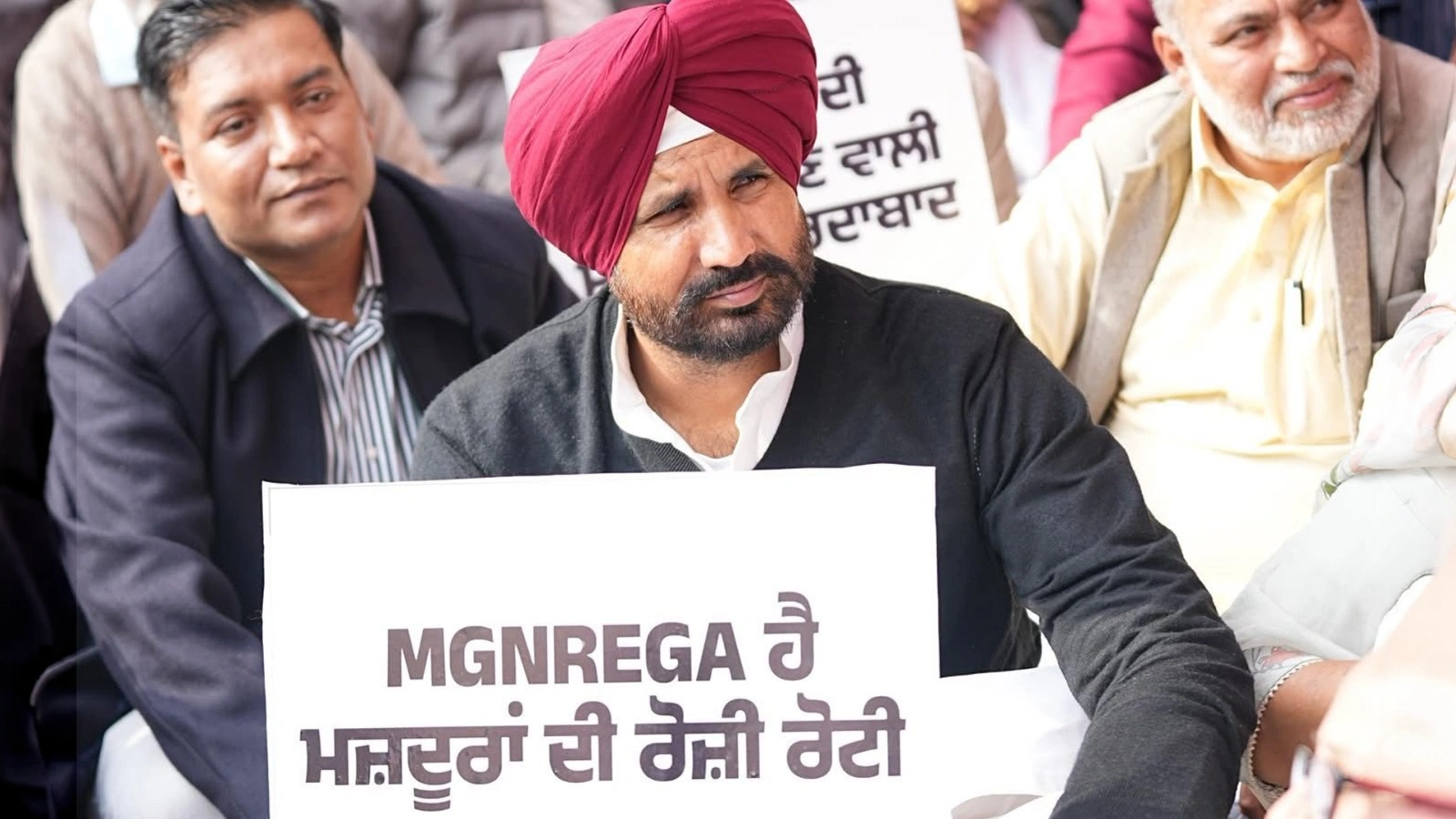
MGNREGA (also called NREGA or Mahatma Gandhi Rojgar Yojana) guarantees every adult in a rural Punjab household up to 100 days of paid unskilled work per year. The daily wage in Punjab for 2025–26 is ₹346, paid directly to your bank account. To apply, visit your Gram Panchayat with your Aadhaar, ration card, and bank details - a Job Card must be issued within 15 days, free of cost. If work is not provided within 15 days of your demand, you are legally entitled to an unemployment allowance. From July 1, 2026, MGNREGA is being replaced by the VB-G RAM G Act, which raises the guarantee to 125 days but shifts more financial burden to states - a change Raja Warring and Punjab Congress have actively opposed and protested against.
For millions of rural households across Punjab, the Mahatma Gandhi National Rural Employment Guarantee Act - known widely as MGNREGA or NREGA Punjab - has been the most direct legal guarantee of work and wages that any Indian government has ever extended to its citizens. In 2026, as the scheme undergoes significant legislative change, workers across the state need to understand exactly how rural employment Punjab functions, what MGNREGA wages 2026 are currently paid, and what the transition to the new national framework means for them.
What Is MGNREGA?
MGNREGA - the Mahatma Gandhi Rojgar Yojana - is a rights-based employment programme enacted by Parliament in 2005 and brought into force on 2 February 2006. Its core guarantee is straightforward: every adult member of a rural household who is willing to do unskilled manual work is legally entitled to at least 100 days of wage employment in a financial year. Crucially, this is a demand-driven scheme - the government must respond to the worker's demand for employment, not the other way around.
Under MGNREGA Punjab, if a registered worker submits a formal demand for work and employment is not provided within 15 days, the applicant becomes legally entitled to an unemployment allowance paid by the state government. All wages are credited directly to the worker's bank or post office account through Direct Benefit Transfer (DBT), ensuring transparency and reducing opportunities for wage theft at the local level.
Important Update for 2026: MGNREGA and the New VB-G RAM G Act
Workers with an MGNREGA Punjab list job card must be aware of a significant legislative development in 2026. In December 2025, Parliament passed the Viksit Bharat – Guarantee for Rozgar and Ajeevika Mission (Gramin) Act, 2025 - referred to as the VB-G RAM G Act - which received Presidential assent on 21 December 2025. This new law replaces MGNREGA and comes into force across all rural areas of India from 1 July 2026.
The VB-G RAM G Act increases the statutory employment guarantee from 100 days to 125 days per rural household per financial year. However, the transition has also raised serious concerns: the new framework shifts the Centre–State funding ratio, requiring state governments to cover 40 per cent of costs - up from 10 per cent previously under NREGA Punjab.
For current job card holders, the government has confirmed that all existing verified cards will remain valid until new Gramin Rozgar Guarantee Cards are issued. Ongoing projects under the MGNREGA Punjab list will continue without disruption.
Amarinder Singh Raja Warring, Member of Parliament from Ludhiana and President of the Punjab Pradesh Congress Committee, has been vocal in opposing the legislative changes. On 21 December 2025, he led a statewide protest by Punjab Congress against the VB-G RAM G Bill, staging demonstrations at the Vidhan Sabha in Chandigarh and at district headquarters across Punjab. Warring and the Punjab Congress demanded that the Bhagwant Mann-led government announce a Punjab-specific rural employment scheme to protect workers whose rights, they argued, were being diluted by the new central legislation. The party highlighted that Punjab had provided over 11 crore person-days of MGNREGA work in 2024–25, with the programme benefiting landless labourers, Dalits, and women workers the most.
Who Is Eligible for MGNREGA in Punjab?
Eligibility under MGNREGA Punjab has always been deliberately inclusive. There are no restrictions based on caste, gender, income level, or landholding. The core eligibility conditions are:
- The applicant must be an Indian citizen.
- The applicant must be at least 18 years of age.
- The applicant must be a permanent resident of a Gram Panchayat (village) within a rural area, as defined in census records.
- The applicant must be willing to perform unskilled manual work.
There are no income-based tests, and no documentary proof of poverty is required. This makes MGNREGA one of India's most universally accessible rural employment programmes in Punjab.
MGNREGA Wages 2026 in Punjab - Current Rates
MGNREGA wages 2026 are notified annually by the Ministry of Rural Development under Section 6(1) of the Act, based on changes in the Consumer Price Index for Agricultural Labour (CPI-AL).
For financial year 2025–26, effective from 1 April 2025, the notified daily MGNREGA wage rate for workers in Punjab is ₹346 per day. This represents an increase from the previous year's rate. The national range for FY 2025–26 runs from ₹241 per day in Nagaland to ₹400 per day in Haryana.
All MGNREGA wages 2026 are paid directly into the worker's bank account via DBT and must be disbursed within 15 days of the closure of the muster roll. Workers are also entitled to compensation at a rate of 0.05 per cent of unpaid wages per day for any delay beyond the 16th day.
Raja Warring, one of Punjab Congress's most visible advocates on worker and employment issues, has consistently raised concerns about MGNREGA wage adequacy and timely disbursement in Punjab...
How to Apply for MGNREGA in Punjab - Step by Step
Step 1 - Visit Your Gram Panchayat Office
The first step to access NREGA Punjab benefits is to visit the local Gram Panchayat office and collect an MGNREGA application form (Form 1). In many villages, a written application on plain paper is also accepted.
Step 2 - Fill in the Application
The application requires the name, age, and gender of each adult member of the household who wishes to work, the name of the Gram Panchayat and village, and the caste or category of each household member (SC, ST, OBC, or General).
Step 3 - Attach Required Documents
The following documents must be attached:
- Aadhaar Card of all working-age adult members
- Ration Card
- Bank passbook or account details
- Passport-size photographs of each adult member
Step 4 - Submit and Obtain a Receipt
Submit the completed form with documents to the Gram Rozgar Sahayak (village employment assistant) or directly at the Gram Panchayat office. A receipt of submission should be obtained and kept safely.
Step 5 - Job Card Issued Within 15 Days
The Gram Panchayat is legally required to issue a Job Card within 15 days of receiving a completed application. The MGNREGA Punjab list Job Card is issued free of cost and contains a photograph of each registered household member. It serves as legal proof of entitlement to demand work under NREGA Punjab.
If the Gram Panchayat delays issuance beyond 15 days without valid reason, applicants can escalate the matter in writing to the Block Development Officer (BDO).
Step 6 - Demand Work in Writing
Once the Job Card is in hand, the household can submit a written demand for work. Employment must be provided within 15 days of this demand. If it is not, unemployment allowance provisions under MGNREGA Punjab come into effect.
Online Process - Checking MGNREGA Punjab List and Status
Workers who have access to the internet or a smartphone can apply online and check their MGNREGA Punjab list status through the official NREGA portal at nrega.nic.in or through the UMANG mobile application.
To verify Job Card status online:
- Go to nrega.nic.in
- Select Punjab as the state
- Select the relevant district, block, and Gram Panchayat
- Search by name in the MGNREGA Punjab list to find Job Card details and payment history
This allows workers to verify whether their wages have been credited, how many days of work have been recorded, and whether any pending dues are outstanding.
Why MGNREGA Matters for Punjab's Rural Workers
Punjab's rural economy is heavily dependent on agriculture, and seasonal unemployment has historically pushed landless labourers and marginal farmers into cycles of debt and distress. Rural employment Punjab through MGNREGA has served as a critical income buffer during the lean agricultural months, particularly for Dalit households, women workers, and those without land or stable employment.
As Raja Warring has argued consistently - including in his December 2025 protest and in Parliament - the guarantee of rural employment Punjab cannot be allowed to weaken. His position is that workers must not lose legal entitlements as the country transitions from MGNREGA to the new VB-G RAM G framework.
Workers in Punjab who have not yet registered are encouraged to approach their nearest Gram Panchayat before 1 July 2026 to ensure their entitlements are protected under the mahatma gandhi rojgar yojana framework before the transition takes effect.
Read more aboutRaja Warring's political journey and public advocacy or return to theArticles section for more updates on Punjab's key issues.
Join the Movement
Punjab's rural workers have waited long enough. Every landless labourer, every woman who depends on NREGA Punjab wages, every family that relies on MGNREGA Punjab during the lean months - they all deserve a leader who fights for their rights without compromise.
Amarinder Singh Raja Warring has stood on the ground with rural workers and in Parliament for them. If you believe Punjab's farmers and labourers deserve fair wages, guaranteed work, and a government that does not shift the burden onto states and workers - add your name to the movement.