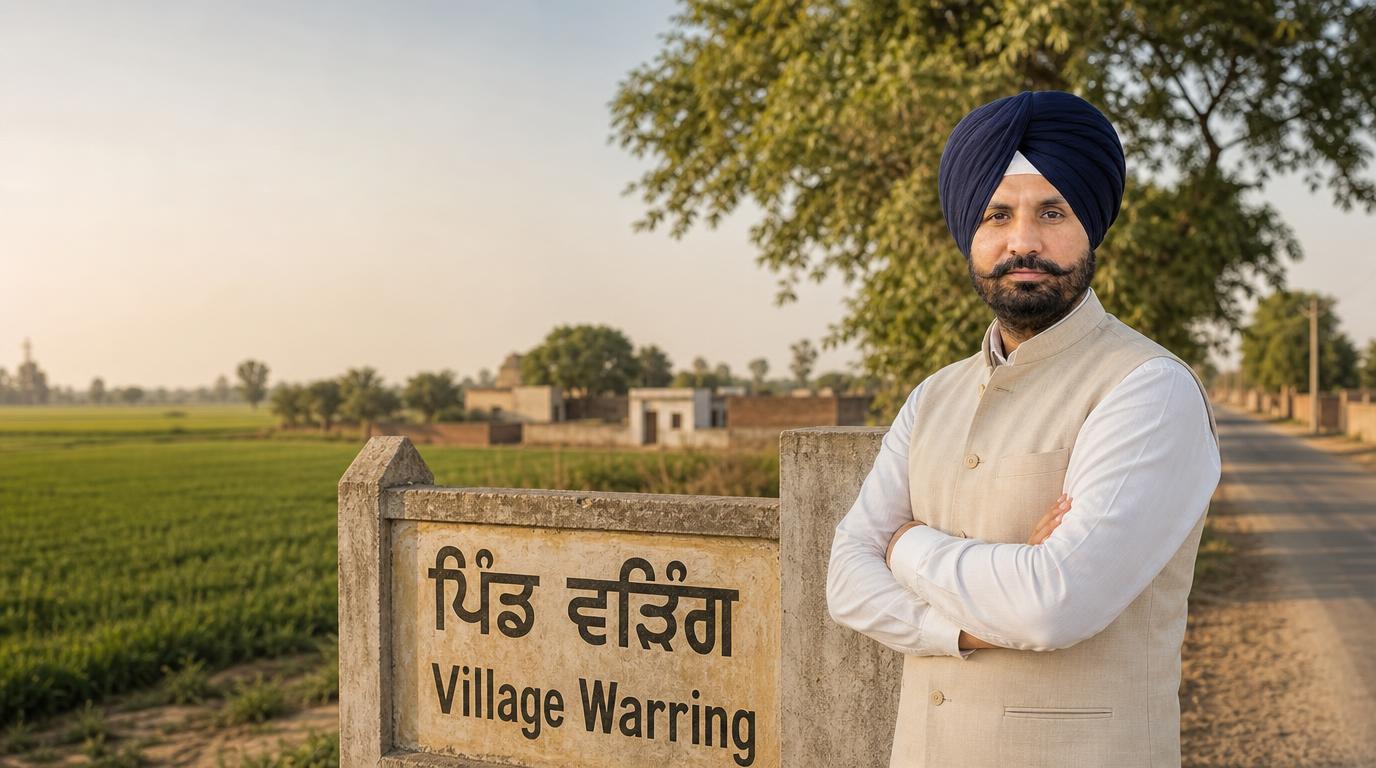
Every political leader has a story that begins long before public office, elections, or headlines. For Amarinder Singh Raja Warring, that story begins in the villages of Sri Muktsar Sahib, where family roots, community ties, and a deep connection with Punjab's rural life helped shape the leader he would eventually become.
As Raja Warring's public profile has grown across Punjab and India, many people have become curious about his family background, community roots, and the story behind the name by which he is widely known. While searches often focus on questions about caste or community, the larger story is one of heritage, identity, and a lifelong connection with the people of Punjab.
From Amarinder Singh Brar to Raja Warring
Today, Punjab knows him as Raja Warring, but that was not always the name by which people recognized him.
Born as Amrinder Singh, he faced personal tragedy early in life when he lost his parents at a young age. He was subsequently raised by his maternal family in Sri Muktsar Sahib, whose support played an important role in shaping his upbringing.
Because he grew up within his maternal family's household and village environment, many people knew him as Raja Sotha, a name connected to the village of Sotha. In rural Punjab, it is common for individuals to be identified by the village with which they are closely associated, and the name naturally became part of his identity.
Over time, he also became known as Raja Brar, reflecting the Brar lineage of the maternal family that raised him. Among friends, associates, and some political circles, the name remained familiar for years.
Later, as he entered mainstream politics, he adopted Warring, the name of his paternal ancestral village near Sri Muktsar Sahib. The change reflected a reconnection with his paternal roots and ancestral heritage. Over time, Raja Warring became the public identity recognized throughout Punjab and beyond.
The journey from Raja Sotha to Raja Brar and eventually Raja Warring reflects the influence of both the family that raised him and the heritage from which he came.
A Jat Sikh Family Rooted in Punjab
Amarinder Singh Raja Warring comes from a Jat Sikh family in Sri Muktsar Sahib, Punjab. His upbringing was closely connected to the traditions, culture, and everyday realities of rural Punjab.
The Malwa region, where Muktsar is located, has long played an important role in Punjab's agricultural and social life. Growing up in this environment gave him firsthand exposure to the concerns of farming families, rural youth, small businesses, and local communities.
These experiences would later influence many of the issues he chose to champion in public life, including agriculture, employment opportunities, education, and accountable governance.
While community background forms part of his personal story, it is only one chapter in a journey that would eventually take him from village roots to leadership roles at the state and national level.
Growing Up in Sri Muktsar Sahib
Sri Muktsar Sahib occupies a special place in Punjab's history and identity. It is a district known not only for its agricultural importance but also for its rich cultural and historical heritage.
For Raja Warring, growing up in this region meant understanding Punjab not through reports or statistics, but through lived experience. The challenges faced by ordinary families, the aspirations of young people, and the importance of community support were all realities he witnessed from an early age.
This close connection to grassroots Punjab continues to be reflected in his political approach and public interactions.
Whether meeting farmers, students, workers, or local residents, he often emphasizes listening to people's concerns directly rather than viewing issues from a distance.
How His Roots Shaped His Political Identity
Punjab's political landscape has always been closely connected to its villages and communities. Leaders who understand the realities of everyday life often build strong relationships with the people they represent.
For Raja Warring, his rural upbringing helped shape a political outlook centered on accessibility, public engagement, and grassroots participation. Rather than emerging solely through inherited influence, he built his political career through years of organizational work and direct interaction with people.
His journey through the Youth Congress gave him opportunities to connect with young Indians across the country while remaining firmly rooted in Punjab's realities. That experience helped prepare him for larger leadership responsibilities in the years that followed.
From Youth Leader to Punjab Congress President
Raja Warring's political journey reflects steady growth through public service and organizational leadership.
Over the years, he has served in several significant roles, including:
- National President of the Indian Youth Congress
- MLA from Gidderbaha
- Cabinet Minister in the Punjab Government
- President of the Punjab Pradesh Congress Committee
- Member of Parliament from Ludhiana
Each of these responsibilities expanded his engagement with people from different regions, backgrounds, and communities.
While his roots remain firmly connected to Sri Muktsar Sahib and the Malwa region, his leadership responsibilities today extend across Punjab and beyond.
More Than a Question of Caste
Many visitors arrive at this page searching for terms such as "Raja Warring caste," "Raja Warring Jat Sikh," "Raja Warring religion," or "Raja Warring family background."
The factual answer is that Raja Warring comes from a Jat Sikh background and traces his ancestral roots to village Warring in Sri Muktsar Sahib, Punjab.
However, family background is only one part of his story. His journey in public life spans decades of grassroots political work, youth leadership, public service, and advocacy on issues affecting Punjab and its people.
Readers interested in learning more about Raja Warring's early life, political journey, public service, and vision for Punjab can explore the Articles and About sections of this website. These sections provide deeper insight into the experiences, challenges, and priorities that have shaped his leadership over the years.
From his roots in Sri Muktsar Sahib to his responsibilities as a Member of Parliament and President of the Punjab Pradesh Congress Committee, Raja Warring's story reflects a continuing commitment to Punjab, its people, and its future.
Join the Movement
Punjab's future depends on citizens who stay engaged, raise important issues, share ideas, and contribute to positive change.
Whether your concern is education, employment, agriculture, youth opportunities, public services, or local development, your voice matters.
Join a growing community of Punjabis working toward a stronger, more prosperous, and more accountable Punjab.