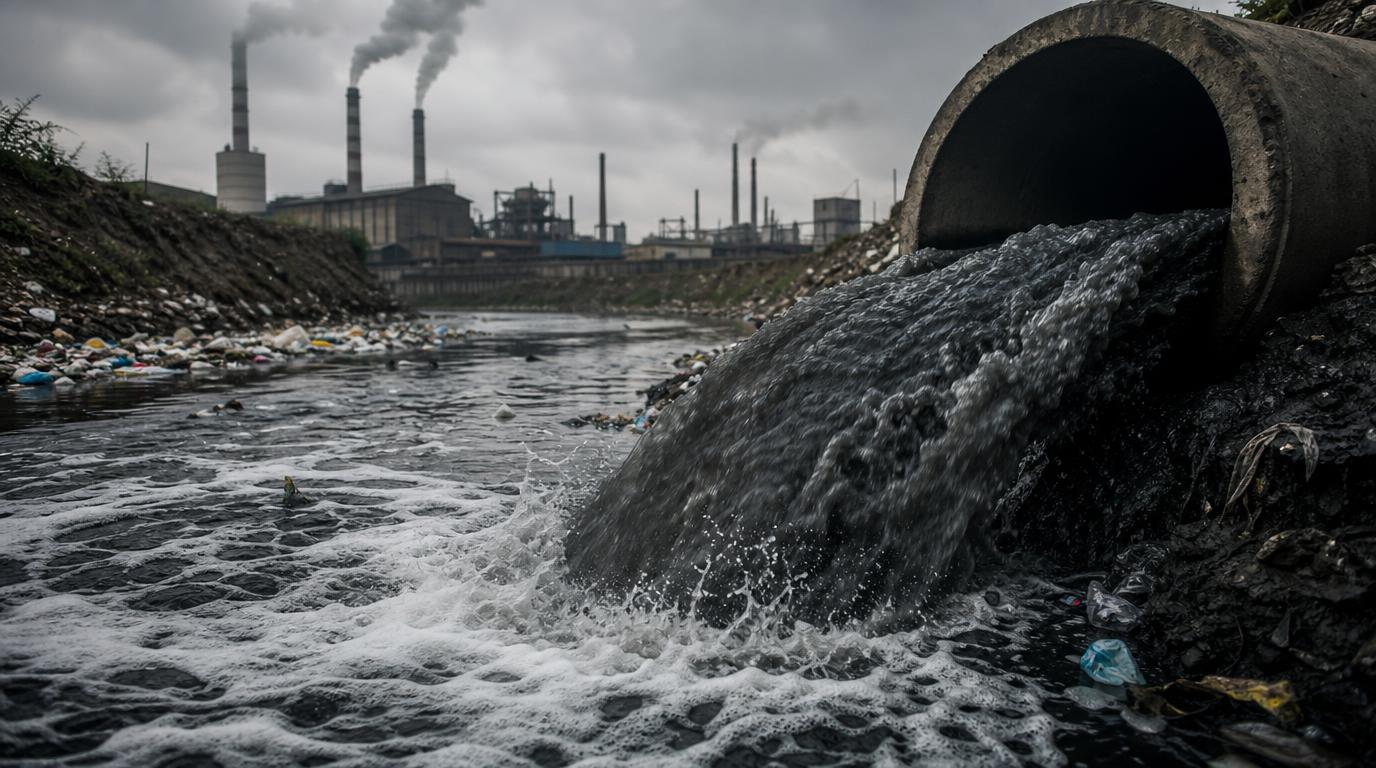
Buddha Nullah is a heavily polluted stream running through Ludhiana, Punjab, that carries industrial wastewater and domestic sewage before joining the Sutlej river at Walipur, affecting drinking water for thousands of families across the Malwa region. In April 2024, a Central Pollution Control Board (CPCB) inspection found that three of four wastewater treatment plants in Ludhiana — Tajpur Road, Tajpur-Rahon Road, and Bahadur Ke Road — were releasing effluent exceeding permitted pollution standards, in violation of their zero-discharge clearances. On 12 August 2024, CPCB directed the Punjab Pollution Control Board (PPCB) to take corrective action, resulting in ₹2.77 crore in environmental compensation. Ludhiana MP Amarinder Singh Raja Warring raised the issue in the Lok Sabha on 16 December 2024 through Unstarred Question No. 3280, seeking accountability on drinking water safety, treatment plant compliance, and corrective action taken. As of April 2026, water quality has improved at some monitoring points, but sewage treatment and unauthorised discharge concerns remain unresolved.
Buddha Nullah History — From Buddha Dariya to an Industrial Drain
Buddha Nullah was not always a drain. Historically known as Buddha Dariya, it was once a natural watercourse and a meaningful part of the region's ecology. Today it runs through Ludhiana carrying domestic sewage, industrial wastewater, and other pollutants before joining the Sutlej at Walipur — a river system that communities and farmers across the Malwa region depend on downstream.
For Ludhiana's residents, this is no longer only an environmental question. It is a question of public health, government responsibility, and the right to clean water.
Why Buddha Nullah Pollution Matters for Ludhiana and Malwa
Ludhiana is one of Punjab's most important industrial centres, and its textile, dyeing, and manufacturing sectors employ thousands of families. But that growth cannot come at the cost of the city's water and public health.
Industrial wastewater from dyeing and manufacturing units can carry organic pollutants, salts, and chemicals. Domestic sewage, dairy waste, stormwater drains, and illegal discharge points add to the load. This isn't the failure of one factory or one plant — it reflects a system in which industrial units, sewage treatment facilities, municipal authorities, and pollution-control agencies have not consistently kept polluted water out of the nullah.
An earlier government survey identified more than 240 pollution points across Ludhiana's water bodies, including multiple points feeding directly into Buddha Nullah — underlining that this is a citywide infrastructure problem, not an isolated one.
CPCB Report on Buddha Nullah — What the April 2024 Inspection Found
In April 2024, CPCB inspected four plants in Ludhiana that treat industrial wastewater. Three were releasing effluent above permitted limits:
| Treatment plant | What CPCB found |
| Tajpur Road — 40 MLD | Chloride: 2,284 mg/L; permitted standard: 1,000 mg/L. BOD and COD also exceeded the limits. |
| Tajpur-Rahon Road — 50 MLD | COD: 382 mg/L; permitted standard: 250 mg/L. |
| Bahadur Ke Road — 15 MLD | COD: 587 mg/L. Chloride and sulphide also exceeded the limits. |
| Focal Point — 500 KLD | Zero Liquid Discharge system in place; no standards exceeded |
(MLD = million litres/day, KLD = thousand litres/day, BOD/COD = standard measures of wastewater pollution)
These weren't marginal breaches. At Tajpur Road, chloride levels were more than double the permitted standard. At Bahadur Ke Road, COD was also more than double the prescribed limit.
The Zero-Discharge Violation — Illegal Pipelines Into Buddha Nullah
The three non-compliant plants held environmental clearances that legally required zero discharge into Buddha Nullah. CPCB found that treated effluent was still being released into the nullah through underground pipelines — meaning these plants were violating both discharge standards and the specific terms of their environmental clearance.
On 12 August 2024, CPCB directed PPCB to take corrective action and impose environmental compensation. PPCB later reported ₹2.77 crore in compensation had been imposed, along with a bank guarantee from one operator. What hasn't been made public: how much of that ₹2.77 crore has actually been recovered, and whether the illegal pipelines have been permanently sealed.
Raja Warring Raises Buddha Nullah in Parliament — Lok Sabha Question 3280
On 16 December 2024, Ludhiana MP Amarinder Singh Raja Warring raised the issue in the Lok Sabha through Unstarred Question No. 3280, seeking answers on three points:
- Whether the government was aware that Sutlej water at Walipur is used for drinking by thousands of Malwa families
- Whether wastewater from dyeing units remained toxic and non-compliant even after treatment
- What action had followed CPCB's direction to PPCB against the violating plants
The Ministry of Environment, Forest and Climate Change confirmed CPCB's findings in its written reply — placing the violation officially on parliamentary record. Warring also raised Buddha Nullah as a priority at a District Development Coordination and Monitoring Committee meeting in Ludhiana in January 2025.
A parliamentary record is not the same as a resolved problem. Residents still need confirmation that the illegal outlets are sealed, the plants have been fixed, and the penalties have actually been recovered.
Buddha Nullah Water Quality in 2026 — Progress and Unanswered Questions
Between January and April 2026, water quality improved sharply at one monitoring point near Bhammia Wali Puli: BOD dropped from 93 to 7, and COD fell from 312 to 32. That is a genuinely significant improvement, and it should be acknowledged as one.
But it answers only part of the question. The 2024 findings identified specific non-compliant treatment plants and an illegal discharge network — and there has been no public confirmation that those specific violations were corrected, that the ₹2.77 crore penalty was recovered, or that the pipelines were sealed. A single improved monitoring reading, without that confirmation, doesn't close the accountability question CPCB and Parliament opened in 2024. It raises a sharper one: what fixed it, and will it hold?
Buddha Nullah — Quick Facts
- Length: ~36 km (Kumbkalan to Ludhiana: 13 km; Ludhiana to Sutlej confluence: 23 km)
- Width: 12–24 metres
- Average depth: 0.6–1.8 metres
- Average flow: ~600 MLD (monitored by CPCB)
- Confluence point: Joins the Sutlej River at Walipur (Wajipur Kalan), Ludhiana district
- Historical name: Buddha Dariya — once a natural, fresh-water stream
- Historical ecology: Home to around 56 fish species before 1964; now supports no fish due to toxicity levels
What Comes Next
Buddha Nullah's cleanup will be complete only when industrial discharge, untreated sewage, and unauthorised outlets are permanently and verifiably controlled — not just improved at a single measuring point. Raja Warring has committed to continuing to press for clean water, transparent monitoring, and full accountability for the people of Ludhiana and the Malwa region.
To learn more about Raja Warring's parliamentary work, read about the 82 questions he raised and 18 debates in the 18th Lok Sabha. You can also read his full biography, explore his political journey with the Congress, and learn about the major campaigns he has led. For more articles and updates, visit the articles section.
Join the Movement
Thousands of families in the Malwa region are still drinking water that a Parliament question and a government inspection have already confirmed was contaminated. That doesn't change on its own — it changes when people keep raising it and keep demanding answers.
If you've seen pollution, infrastructure failures, or public service breakdowns in your area, report it here — or if you want to be part of the larger push for accountability across Punjab, Join the Movement.